


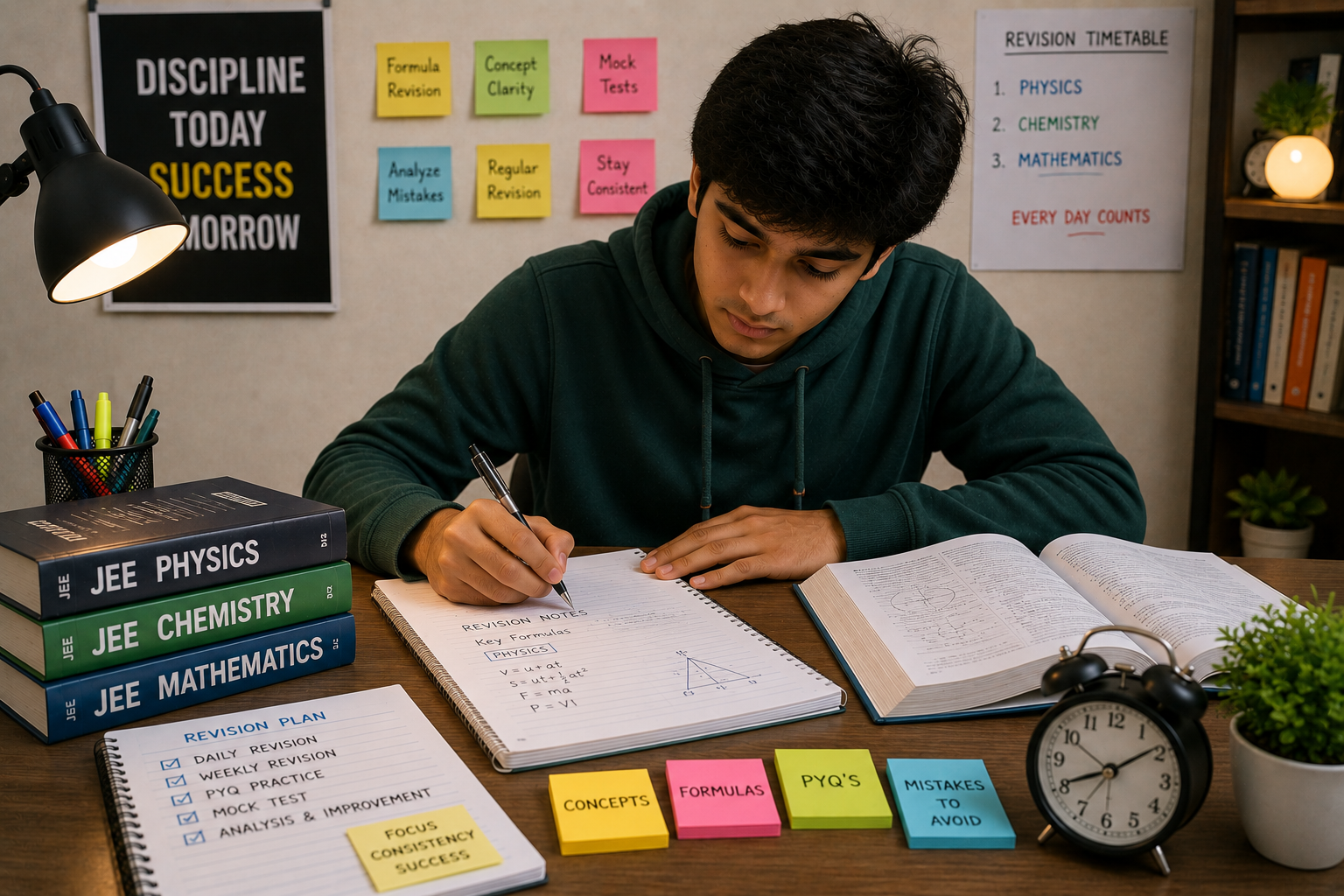
JEE Revision Strategy: How to Revise Effectively for JEE Main and JEE Advanced
Completing the JEE syllabus is only one part of preparation. The real challenge is remembering concepts, formulas, reactions and problem-solving methods until the examination.
Many students spend months completing chapters but struggle during mock tests because they have not revised older topics properly. A chapter that was once clear can become weak if it is not revisited regularly.
This is why revision should not be something you start only after completing the entire syllabus.
A strong JEE revision strategy can be summarised as:
Learn → Revise → Practise → Test → Analyse → Re-Revise
The goal of revision is not simply to read the same chapter again. Effective revision should help you recall information, strengthen weak concepts and improve your ability to solve questions under exam conditions.
Why Is Revision Important for JEE?
JEE preparation covers a large syllabus across Physics, Chemistry and Mathematics.
Over time, students may forget:
- Important formulas
- Concepts
- Reactions
- Theorems
- Shortcuts
- Problem-solving methods
- Exceptions
- Mistakes made during practice
Without regular revision, you may feel like you have studied a chapter before but cannot solve questions from it.
Revision helps you move information from short-term understanding towards long-term retention.
It also improves speed because concepts and formulas become easier to recall.
When Should You Start Revising for JEE?
Start from the beginning.
Do not wait until Class 12 is completed or until a few months before the examination.
Every chapter should go through multiple revision cycles.
For example:
First Revision
Revise shortly after completing the chapter.
Second Revision
Revisit the chapter after a few days.
Third Revision
Review it again after a few weeks.
Long-Term Revision
Continue revisiting the chapter during the following months.
This repeated exposure helps prevent older chapters from becoming weak.
The Best JEE Revision Cycle
A useful revision cycle is:
Daily Revision → Weekly Revision → Monthly Revision → Test-Based Revision
Daily Revision
Spend some time reviewing what you studied recently.
This can include:
- Important concepts
- Formulas
- Reactions
- Examples
- Difficult questions
The purpose is to strengthen newly learned information.
Weekly Revision
At the end of the week, review the important topics you studied.
Ask yourself:
- What did I learn this week?
- Which topics are still unclear?
- Which formulas do I forget?
- Which questions caused problems?
Use this revision session to clear small gaps before they become bigger problems.
Monthly Revision
Every month, revisit older chapters.
This is especially important because students often focus only on their current syllabus.
Monthly revision helps maintain contact with topics studied earlier.
Test-Based Revision
Every test provides a personalised revision plan.
If you make mistakes in a topic, revise it.
Your test results can help you identify exactly where your revision time is needed.
Do Not Revise Everything in the Same Way
Physics, Chemistry and Mathematics require different revision approaches.
A single revision method may not work equally well for all three subjects.
JEE Physics Revision Strategy
Physics revision should focus on concepts and applications.
Instead of only reading formulas, ask yourself:
- What does this formula represent?
- When can it be applied?
- What are its limitations?
- Which type of questions use this concept?
A good Physics revision session can include:
- Review important concepts.
- Revise formulas.
- Look at important diagrams.
- Re-solve selected questions.
- Review previous mistakes.
- Attempt mixed questions.
For difficult chapters, focus on the concepts that connect different problems.
For example, instead of revising every Mechanics question, revise the main principles:
- Newton’s laws
- Work-energy theorem
- Conservation of energy
- Conservation of momentum
Then practise questions that apply these principles in different situations.
JEE Chemistry Revision Strategy
Chemistry should be revised differently depending on the branch.
Physical Chemistry Revision
Focus on:
- Important formulas
- Concepts
- Numerical methods
- Units
- Common mistakes
Re-solve selected numerical problems instead of only reading solutions.
Organic Chemistry Revision
Focus on:
- Reaction mechanisms
- Important reagents
- Reaction pathways
- Named reactions
- Conversions
- Exceptions
Use reaction maps to connect different functional groups and reactions.
Instead of memorising reactions separately, try to understand the pattern behind them.
Inorganic Chemistry Revision
Inorganic Chemistry requires frequent short revision sessions.
Focus on:
- Periodic trends
- Important reactions
- Properties
- Exceptions
- Colours
- Coordination compounds
- Important factual information
Active recall can be particularly useful.
Close your book and try to remember the information before checking the answer.
JEE Mathematics Revision Strategy
Mathematics revision should involve active problem-solving.
Simply reading formulas is usually not enough.
A good Mathematics revision session includes:
- Formula review
- Important concepts
- Selected solved examples
- Difficult questions
- Previous mistakes
- Mixed-topic problems
Re-solve questions instead of only reading their solutions.
If you can solve an old difficult question again without help, it is a good sign that the concept has become stronger.
Create Short Revision Notes
Long notes can become difficult to revise during the final stages of preparation.
Create concise revision material for every subject.
Your notes can include:
Physics
- Important formulas
- Key concepts
- Conditions and assumptions
- Important diagrams
- Common mistakes
Chemistry
- Important reactions
- Formulas
- Exceptions
- Periodic trends
- Mechanisms
- Important facts
Mathematics
- Formulas
- Theorems
- Standard methods
- Important tricks
- Frequently repeated mistakes
The purpose is to create material that you can revise quickly.
Avoid spending too much time making notes perfect.
Useful notes are more important than attractive notes.
Use Active Recall Instead of Only Reading
Passive reading can create a false sense of preparation.
You may recognise a formula while reading it but fail to remember it during a test.
Active recall is more effective.
Try methods such as:
- Close the book and write formulas from memory.
- Solve a question without looking at the method.
- Recall important reactions.
- Explain a concept in your own words.
- Create questions for yourself.
This helps identify what you actually remember.
Re-Solve Important Questions
During preparation, you will encounter questions that teach important concepts.
Do not solve them once and forget them.
Mark questions that are:
- Difficult
- Conceptually important
- Based on common mistakes
- Multi-concept
- Useful for revision
Create a list of selected questions for each chapter.
During revision, solve these instead of randomly repeating every question from your book.
This can save time while maintaining quality practice.
Maintain an Error Notebook
Your mistakes are valuable revision material.
Whenever you make an important error, record:
Topic → Mistake → Reason → Correct Method
For example:
Topic: Electrostatics
Mistake: Applied the electric field formula incorrectly inside a conductor.
Reason: Did not revise the properties of electrostatic equilibrium.
Lesson: Review the conditions inside and outside a conductor.
Your error notebook should be revised regularly.
If the same mistake appears again, identify why your previous revision was not effective.
How to Revise Weak Chapters
Do not avoid weak chapters because they feel difficult.
Break them into smaller parts.
For example:
Weak Chapter → Identify Specific Problem → Revise Concept → Solve Basic Questions → Solve Moderate Questions → Test Again
Do not spend all your time trying to master the hardest questions.
First strengthen the basics.
Once your foundation improves, advanced problems become easier to handle.
Use the 80/20 Revision Approach
During revision, not every topic may require the same amount of attention.
Identify the areas where you:
- Frequently make mistakes
- Forget formulas
- Take too much time
- Lack confidence
- Leave questions unattempted
Give additional attention to these topics.
At the same time, continue revising your stronger chapters so they remain strong.
The goal is to use your time intelligently.
How to Revise After a Mock Test
Mock test analysis should directly influence your revision.
After a test, divide mistakes into categories:
Conceptual Mistakes
Revise the theory and solve related questions.
Formula Mistakes
Add the formula to your revision list and practise applying it.
Calculation Mistakes
Practise writing steps carefully and checking calculations.
Careless Mistakes
Identify the pattern.
For example:
- Missing negative signs
- Misreading questions
- Marking the wrong option
Time Management Problems
Practise question selection and timed problem-solving.
Your revision should solve the problems revealed by your tests.
A Practical Daily JEE Revision Routine
You do not need to spend your entire day revising old topics.
A balanced study routine can include:
Current Study
Focus on new chapters and concepts.
Short Revision Session
Review recently studied topics.
Older Topic Revision
Spend some time revising an older chapter.
Question Practice
Solve questions from current and previous topics.
This keeps your preparation balanced.
How to Revise When the Exam Is Close
As the examination approaches, your revision should become more focused.
Avoid constantly adding new study material.
Focus on:
- Formula notebooks
- Short notes
- Important reactions
- Error notebooks
- Previous year questions
- Mock test mistakes
- Weak but recoverable topics
The final stage is not the best time to start multiple new books.
Use familiar resources and strengthen what you have already studied.
Create a Revision Priority List
Divide your topics into three categories.
Strong Topics
You understand them well and can solve questions confidently.
Revise them periodically to maintain confidence.
Moderate Topics
You understand the basics but make occasional mistakes.
These topics can improve significantly with focused revision.
Weak Topics
You struggle with concepts or problem-solving.
Break these into smaller areas and work on the fundamentals.
A priority list helps you avoid random revision.
Avoid These Common Revision Mistakes
1. Waiting Until the Entire Syllabus Is Complete
Start revising from the beginning.
2. Reading Without Testing Yourself
Use active recall and questions.
3. Revising Only Favourite Chapters
Weak areas need attention too.
4. Making Too Many New Notes
Your revision material should save time, not create additional work.
5. Ignoring Previous Mistakes
Your mistakes show exactly what requires revision.
6. Solving Only New Questions
Re-solving important questions can strengthen concepts and confidence.
7. Revising Randomly
Follow a structured revision plan.
8. Ignoring Mock Test Analysis
Every mock test should influence your next revision cycle.
A Weekly JEE Revision Strategy
A simple weekly structure can look like this.
Monday to Friday
Focus on:
- Current topics
- Daily revision
- Question practice
Saturday
Focus on:
- Weak chapters
- Important questions
- Formula and reaction revision
Sunday
Focus on:
- Mixed revision
- Mock or part-syllabus test
- Test analysis
- Planning the next week
Adjust this according to your school, coaching and preparation schedule.
The Final Revision Strategy Before JEE
During the final phase, focus on revision rather than collecting new material.
A useful approach is:
Formulas → Concepts → Important Questions → PYQs → Mock Tests → Mistake Analysis
Avoid changing your entire preparation strategy at the last moment.
Use methods and resources that you have already practised with.
The goal is to improve confidence, speed and accuracy.
Final Thoughts
A successful JEE revision strategy is not about reading the entire syllabus repeatedly.
It is about revisiting the right information at the right time.
Your revision should be:
- Regular
- Active
- Focused
- Test-based
- Connected to your mistakes
Remember the cycle:
Learn → Revise → Practise → Test → Analyse → Re-Revise
Do not wait for the syllabus to be completely finished before you begin revising.
Start early, maintain a regular revision cycle and use mock tests to identify where your attention is needed.
Physics should be revised through concepts and problem-solving.
Chemistry should be revised according to Physical, Organic and Inorganic requirements.
Mathematics should be revised through formulas and active practice.
The most important thing is consistency.
Even short, regular revision sessions can be more effective than trying to revise everything at the last minute.
With a structured plan, concise revision notes, regular testing and careful mistake analysis, you can keep the JEE syllabus active in your memory and enter JEE Main and JEE Advanced with greater confidence and preparation.
