


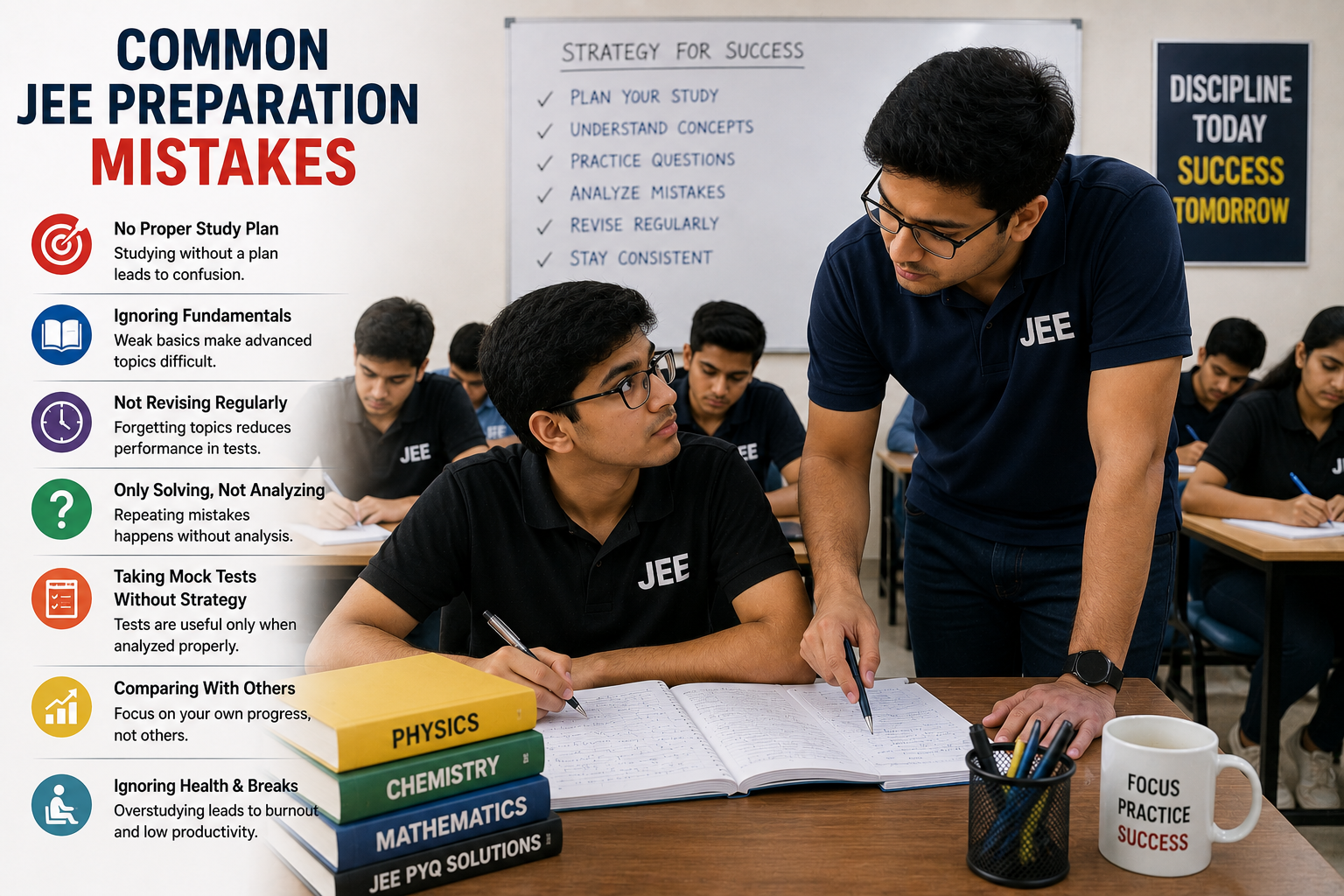
Common JEE Preparation Mistakes and How to Avoid Them
Preparing for JEE Main and JEE Advanced is a long journey that requires consistency, proper planning and regular improvement. Many students work hard for months but still fail to achieve their expected results because of small mistakes in their preparation strategy.
The problem is often not a lack of effort. It is that the effort is being directed in the wrong way.
Some students study for long hours but do not revise properly. Some complete multiple books but do not analyse their mistakes. Others keep changing their strategy, ignore weak chapters or take mock tests without learning from them.
Understanding these common mistakes can help you avoid wasting valuable time and make your JEE preparation more effective.
A better approach is:
Plan → Learn → Practise → Analyse → Revise → Improve
1. Starting Without a Clear Study Plan
One of the biggest mistakes is studying randomly without knowing what needs to be completed.
For example, a student may study Mathematics one day, switch to an unrelated Chemistry chapter the next day and then spend several days solving random Physics questions.
This can create the feeling of being busy without making consistent progress.
How to Avoid It
Create a flexible study plan that includes:
- Current chapters
- Older chapter revision
- Question practice
- Mock tests
- Weak topics
You do not need to plan every minute of your day. A realistic weekly plan is usually more useful than an overly strict schedule.
Track your progress and adjust the plan when necessary.
2. Focusing Only on Completing the Syllabus
Completing a chapter does not mean you have mastered it.
Many students finish the syllabus quickly but cannot solve questions from older chapters after a few months.
JEE preparation is not a race to finish the maximum number of chapters.
A better goal is:
Learn → Practise → Revise → Test
After completing a chapter, solve questions and revisit it regularly.
A smaller number of well-prepared chapters is more valuable than a large number of chapters studied without understanding.
3. Ignoring the Basics
Some students rush towards difficult JEE Advanced-level questions without building a strong foundation.
This often leads to frustration.
Advanced problems are usually built on basic concepts.
For example, if your understanding of Newton’s laws is weak, difficult Mechanics questions will feel confusing. If your fundamentals in General Organic Chemistry are weak, advanced Organic Chemistry may become difficult.
How to Avoid It
Whenever you struggle repeatedly with a topic, go back to the basics.
Ask yourself:
- Do I understand the fundamental concept?
- Can I explain it in simple words?
- Can I solve basic questions?
- Do I know why the formula or method works?
Strengthening the foundation often solves the problem.
4. Memorising Without Understanding
Memorisation is useful in some parts of JEE preparation, especially for certain facts, formulas and reactions.
However, memorising without understanding can become a problem.
A student may remember a formula but not know when to use it.
Similarly, memorising an Organic Chemistry reaction without understanding the mechanism can create difficulty when the same concept appears in a different form.
How to Avoid It
Before memorising, understand:
- What the concept means
- Why the formula works
- When it can be applied
- What conditions are required
Conceptual understanding makes memorisation easier and improves problem-solving ability.
5. Using Too Many Books and Resources
Many students collect multiple books, modules, question banks, notes and online resources.
They start one book, leave it incomplete and move to another.
This creates unnecessary confusion.
Having more study material does not automatically mean better preparation.
How to Avoid It
Select a limited number of reliable resources and complete them properly.
Focus on:
- Understanding the theory
- Solving quality questions
- Practising previous year questions
- Revising important material
It is usually better to complete a few resources thoroughly than to partially complete many.
6. Avoiding Weak Subjects or Chapters
Students naturally enjoy studying subjects in which they already perform well.
However, repeatedly studying only your favourite subject can create major gaps.
For example, if Mathematics is your strongest subject, spending most of your time on it while ignoring weak areas in Physics or Chemistry can limit your overall performance.
How to Avoid It
Identify weak areas and divide them into smaller sections.
Instead of thinking:
“I am weak in Physics.”
Identify the specific problem:
- Weak in Mechanics?
- Difficulty with Electrostatics?
- Slow calculations?
- Poor conceptual understanding?
Specific problems are easier to solve.
7. Solving Questions Without Analysing Mistakes
Simply checking whether your answer is correct is not enough.
Every incorrect question contains useful information.
Your mistake may be caused by:
- Weak concepts
- Incorrect formula
- Calculation errors
- Misreading the question
- Poor time management
- Incorrect approach
How to Avoid It
After practice sessions, analyse important mistakes.
Maintain an error notebook using a simple format:
Topic → Mistake → Reason → Correct Approach
Review these mistakes regularly.
The goal is not to avoid making mistakes completely. The goal is to avoid repeating the same mistakes.
8. Looking at Solutions Too Quickly
When students get stuck, they often immediately check the solution.
This may save time in the moment, but it reduces the opportunity to develop problem-solving skills.
JEE questions often require you to think through unfamiliar situations.
How to Avoid It
Spend some time analysing the question before checking the answer.
Try to:
- Draw a diagram
- Write the given information
- Identify the relevant concept
- Break the problem into smaller parts
- Try another approach
If you still cannot solve it, study the solution carefully and understand the logic.
Later, attempt the question again without help.
9. Practising Only Easy Questions
Easy questions are useful for learning concepts and building confidence.
However, solving only familiar questions can create a false sense of preparation.
You may feel comfortable during practice but struggle when the exam presents a new variation.
How to Avoid It
Gradually increase the difficulty level.
A balanced practice session can include:
- Basic questions
- Standard questions
- Moderate questions
- Multi-concept questions
- Advanced problems
Do not jump directly to the hardest level. Build your skills step by step.
10. Practising Only Difficult Questions
The opposite mistake can also be harmful.
Some students believe that solving only the hardest questions will guarantee success.
However, difficult problems cannot replace strong fundamentals.
How to Avoid It
Follow a progression:
Concept → Basic Questions → Standard Application → Mixed Questions → Advanced Problems
This builds confidence and understanding at the same time.
11. Ignoring Revision
One of the most common mistakes is studying new topics continuously while forgetting older ones.
After several months, students may realise that they need to relearn chapters they studied earlier.
How to Avoid It
Use a regular revision cycle:
- Daily revision
- Weekly revision
- Monthly revision
- Test-based revision
Even short revision sessions can help keep older topics active.
Do not wait until the syllabus is complete.
12. Passive Revision
Reading notes repeatedly can feel productive, but recognition is not the same as recall.
You may recognise a formula while looking at it but fail to remember it during a test.
How to Avoid It
Use active revision methods.
Try to:
- Write formulas from memory
- Solve questions without looking at solutions
- Recall reactions
- Explain concepts in your own words
- Test yourself regularly
Active recall helps identify what you actually remember.
13. Not Solving Previous Year Questions
Previous year questions are an important part of JEE preparation.
Ignoring them can leave you unaware of how concepts are actually tested.
How to Avoid It
After completing a chapter, solve relevant previous year questions.
Use them to understand:
- Question patterns
- Difficulty level
- Important concepts
- Common applications
Mark difficult and important questions for future revision.
14. Taking Too Many Mock Tests Without Analysis
Mock tests are useful only when you learn from them.
Some students take one test after another and focus only on their scores.
As a result, they keep repeating the same mistakes.
How to Avoid It
After every test:
- Check your performance.
- Identify incorrect questions.
- Find the reason behind each mistake.
- Revise weak concepts.
- Practise similar questions.
- Apply the improvement in the next test.
The cycle should be:
Test → Analyse → Improve → Retest
15. Focusing Only on the Mock Test Score
A mock test score can be useful, but it does not tell the complete story.
A lower score may result from:
- Poor time management
- Careless mistakes
- Difficult questions
- Weak chapters
- Poor question selection
How to Avoid It
Analyse:
- Accuracy
- Subject-wise performance
- Time spent on questions
- Unattempted but solvable questions
- Repeated mistakes
Your score shows the result. Your analysis shows what to improve.
16. Poor Time Management During Tests
Many students know the concepts but lose marks because they spend too much time on difficult questions.
This can lead to rushing through easier questions near the end.
How to Avoid It
Use a multiple-round approach.
Round 1: Attempt easy and high-confidence questions.
Round 2: Return to moderate questions.
Round 3: Attempt difficult questions if enough time remains.
Mock tests are the best place to develop this habit.
17. Attempting Too Many Questions Without Confidence
Negative marking can make random attempts risky.
Trying to answer every question is not always the best strategy.
How to Avoid It
Focus on:
- Good question selection
- High-confidence attempts
- Accuracy
A well-planned attempt is usually better than rushing through the entire paper.
18. Ignoring Careless Mistakes
Students often say, “I knew the answer, but I made a silly mistake.”
If the same type of mistake happens repeatedly, it is no longer just bad luck.
Common careless mistakes include:
- Missing a negative sign
- Using incorrect units
- Misreading a condition
- Selecting the wrong option
- Calculation errors
How to Avoid It
Identify patterns.
For example, if you often make sign mistakes, consciously check signs before finalising an answer.
Develop a short checking routine during practice and mock tests.
19. Comparing Your Preparation Constantly With Others
Every student has a different starting point, learning speed and preparation style.
Constant comparison can create unnecessary stress.
Seeing someone complete more chapters does not necessarily mean they understand those chapters better.
How to Avoid It
Track your own progress.
Compare:
- Your current performance with previous tests
- Your current accuracy with earlier accuracy
- Your current weak areas with previous weaknesses
Focus on consistent improvement.
20. Changing Your Study Strategy Too Frequently
Students sometimes change their timetable, books, teachers or methods every few weeks.
This prevents consistency.
A strategy usually needs time before you can judge whether it is working.
How to Avoid It
Give a reasonable strategy enough time.
Make changes when your analysis shows a genuine problem.
Do not completely change your preparation method because of one difficult mock test.
21. Ignoring Health and Rest
Long study hours without proper rest can reduce concentration and productivity.
JEE preparation is a long-term process.
Burnout can make even simple tasks feel difficult.
How to Avoid It
Maintain a sustainable routine.
Include:
- Adequate sleep
- Regular breaks
- Physical activity
- A balanced daily routine
Studying effectively is more important than simply sitting with books for long hours.
22. Waiting for the Perfect Time to Start
Some students delay serious preparation because they are waiting for:
- A new timetable
- A new book
- A new coaching batch
- The beginning of a new month
- Monday
This delays progress.
How to Avoid It
Start with what you have.
Even a small, focused study session is better than waiting for perfect conditions.
Improve your system as you continue.
23. Ignoring Exam Temperament
Knowledge alone is not always enough.
The actual JEE examination requires you to stay focused and make decisions under time pressure.
You need to know:
- When to attempt a question
- When to skip it
- When to return later
- How to recover after a difficult question
- How to manage time
How to Avoid It
Take realistic mock tests.
Practise sitting for the full duration and avoid unnecessary interruptions.
Develop an exam strategy before the actual examination.
How to Build a Better JEE Preparation Strategy
Avoiding mistakes is easier when you follow a structured approach.
A practical preparation cycle is:
Step 1: Learn the Concept
Build a strong foundation.
Step 2: Practise Questions
Start with basic questions and gradually increase difficulty.
Step 3: Analyse Mistakes
Find out exactly why you made an error.
Step 4: Revise Regularly
Keep older chapters active.
Step 5: Solve Previous Year Questions
Understand how concepts are tested.
Step 6: Take Mock Tests
Practise under exam-like conditions.
Step 7: Improve Your Strategy
Use test analysis to identify what needs attention.
Then repeat the cycle.
Final Thoughts
JEE preparation is not only about studying harder. It is also about studying smarter.
Many common mistakes can be avoided with regular self-analysis and a structured routine.
Remember:
Do not just study. Understand.
Do not just solve questions. Analyse mistakes.
Do not just complete chapters. Revise them.
Do not just take mock tests. Learn from them.
Do not compare your entire journey with someone else’s progress. Focus on improving your own performance.
The most effective JEE preparation strategy is one that evolves based on your strengths, weaknesses and test performance.
Stay consistent, build strong fundamentals, revise regularly and treat every mistake as an opportunity to improve.
With the right approach and disciplined preparation, you can avoid many of the common mistakes that hold students back and move closer to your JEE Main and JEE Advanced goals.
