


JEE Mock Test Strategy: How to Use Mock Tests Effectively for JEE Main and JEE Advanced
Mock tests are one of the most important parts of JEE preparation. However, simply taking a large number of tests does not automatically improve your score.
A student may take ten, twenty or even fifty mock tests and still make the same mistakes repeatedly. The real improvement happens when you use every test to identify weaknesses, improve your approach and make changes to your preparation.
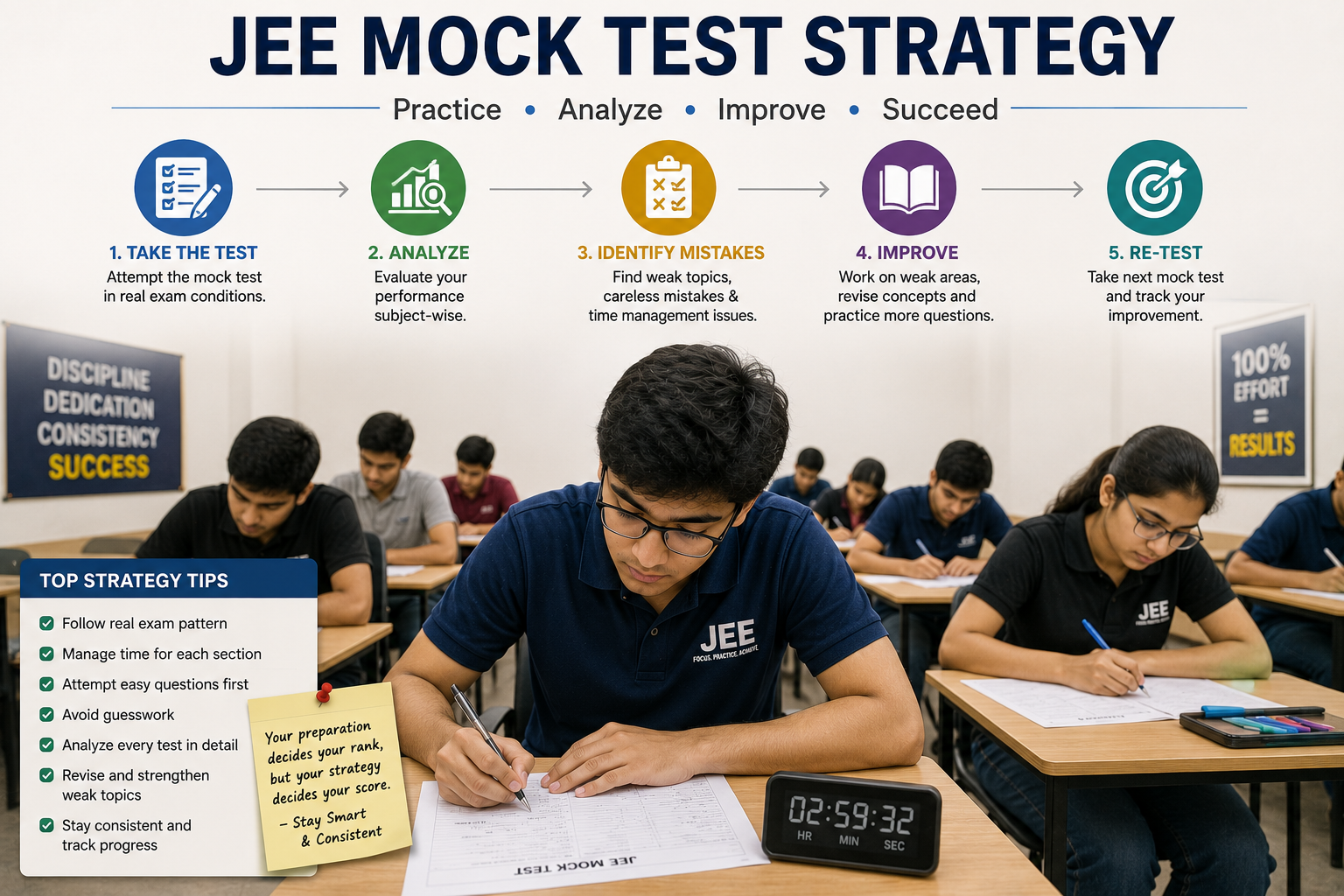
A good JEE mock test strategy can be summarised as:
Take the Test → Analyse Performance → Identify Mistakes → Fix Weak Areas → Revise → Retest
Mock tests should not be treated only as a way to check your marks. They are practice sessions for the actual JEE examination.
They help you improve:
- Time management
- Question selection
- Accuracy
- Speed
- Exam temperament
- Subject balance
- Weak topic identification
- Confidence
The goal is not to score perfectly in every mock test. The goal is to learn from each test and gradually improve your performance.
Why Are Mock Tests Important for JEE Preparation?
JEE preparation involves much more than completing the syllabus.
Even if you understand all the chapters, you may still face problems during the actual examination.
For example:
- You may spend too much time on one difficult question.
- You may make careless calculation mistakes.
- You may struggle to decide which subject to start with.
- You may attempt questions in the wrong order.
- You may panic after getting stuck.
- You may lose marks because of negative marking.
Mock tests help you identify these problems before the actual examination.
The more effectively you analyse your performance, the more useful your mock tests become.
When Should You Start Taking JEE Mock Tests?
You do not need to wait until your entire syllabus is complete.
You can begin with smaller tests.
A good progression is:
Topic-wise Tests → Chapter Tests → Part-Syllabus Tests → Full-Syllabus Mock Tests
Topic-Wise Tests
Take these after completing a specific topic.
They help you check whether you actually understand the concept.
Chapter Tests
These cover an entire chapter and help you identify areas that require revision.
Part-Syllabus Tests
These combine multiple chapters.
They are useful for practising how to switch between different concepts.
Full-Syllabus Mock Tests
These should become an important part of your preparation after covering a significant portion of the syllabus.
Full-length tests help you practise:
- Time management
- Subject selection
- Question selection
- Mental endurance
- Accuracy under pressure
How Often Should You Take Mock Tests?
The frequency depends on your preparation stage.
During the early stage, your focus should mainly be on learning concepts and building a strong foundation.
At this stage, chapter and topic tests can be useful.
As more of the syllabus is completed, increase the frequency of part-syllabus tests.
Closer to the examination, full-length mock tests become more important.
However, do not take so many tests that you do not have time to analyse them.
One properly analysed mock test can be more valuable than several tests where you only check your score.
Create a Real Exam Environment
A mock test is most useful when you treat it like the actual examination.
Try to:
- Sit in a quiet environment.
- Follow the actual test duration.
- Avoid unnecessary breaks.
- Keep your phone away.
- Do not check solutions during the test.
- Use only the materials allowed during the examination.
- Avoid interruptions.
The purpose is to train your mind to remain focused for the full duration of the examination.
If you frequently pause the test, check answers or take long breaks, the result may not accurately reflect your preparation level.
Decide Your Subject Order
There is no universal rule about which subject you should attempt first.
Some students prefer:
Physics → Chemistry → Mathematics
Others may prefer:
Chemistry → Physics → Mathematics
The best order depends on your strengths, confidence and speed.
Use mock tests to experiment.
Ask yourself:
- In which subject am I most confident?
- Which subject takes me the longest?
- Does starting with Mathematics reduce my energy?
- Does Chemistry help me build momentum?
After taking several tests, you may discover an order that works best for you.
Once you find an effective strategy, practise it consistently.
Do Not Solve the Paper in a Straight Line
A common mistake is trying to solve every question in sequence.
This can waste valuable time.
Instead, use a question selection strategy.
During your first pass, identify questions that are:
- Easy
- Familiar
- High confidence
Attempt these first.
During the second pass, attempt questions that require more thinking.
Leave questions that seem highly difficult or unfamiliar for later.
A useful approach is:
Round 1: Easy Questions
Attempt questions where you quickly understand the concept and approach.
Round 2: Moderate Questions
Return to questions that require more time.
Round 3: Difficult Questions
Attempt these only if enough time remains.
This approach can help improve accuracy and time management.
Use the Right Time Management Strategy
Do not divide your time equally between every question.
Some questions may take thirty seconds, while others may take several minutes.
The goal is to maximise your overall score.
If you spend ten minutes on one difficult question, you may lose the opportunity to solve several easier questions.
During mock tests, track:
- Where you spend too much time.
- Which subject consumes the most time.
- Which question types slow you down.
- Whether you are rushing near the end.
Your time management strategy should improve after every test.
Accuracy Is More Important Than Attempting Everything
Many students focus only on the number of questions attempted.
This can be dangerous, especially when negative marking is involved.
Before attempting a question, ask:
- Do I understand the question?
- Do I know the concept?
- Am I confident about the method?
Avoid random guessing.
A balanced strategy is better than attempting a large number of questions with poor accuracy.
Your target should be:
Good Question Selection + High Accuracy + Efficient Time Management
What Should You Do Immediately After a Mock Test?
Do not simply check your score and move to the next test.
The analysis process is where most improvement happens.
After checking the test, divide your questions into categories.
Category 1: Correct and Confident
These are questions you solved correctly and understood.
No major action is required, but note whether your method was efficient.
Category 2: Correct but Took Too Much Time
You understood the concept but used an inefficient approach.
Find a faster method if possible.
Category 3: Incorrect Due to Careless Mistakes
Examples include:
- Wrong sign
- Calculation error
- Incorrect option marked
- Misreading the question
These mistakes can often be reduced through better discipline and checking.
Category 4: Incorrect Due to Conceptual Gaps
These questions reveal weak areas.
Go back and revise the underlying concept.
Category 5: Unattempted but Solvable
These are extremely important.
You may have left the question because:
- You did not recognise the concept.
- You spent too much time elsewhere.
- You lost confidence.
- You did not revisit the question.
Improving question selection can help recover these marks.
Category 6: Difficult or Unknown
These questions may require additional study, but do not become obsessed with every difficult problem.
Focus first on weaknesses that appear repeatedly.
Maintain a Mock Test Analysis Notebook
Keep a separate notebook or digital document for test analysis.
After every mock test, record:
- Test date
- Score
- Subject-wise performance
- Number of correct answers
- Number of incorrect answers
- Number of unattempted questions
- Time management problems
- Important conceptual mistakes
- Careless mistakes
- Topics requiring revision
You can also create a simple table:
| Problem Type | What Happened | Action |
|---|---|---|
| Concept Error | Weak understanding of a topic | Revise theory and solve questions |
| Calculation Error | Made an arithmetic mistake | Practise carefully and check calculations |
| Time Issue | Spent too long on one question | Improve question selection |
| Misread Question | Missed an important condition | Read questions more carefully |
| Guessing Error | Attempted without confidence | Improve attempt discipline |
Review this notebook before your next mock test.
The purpose is to avoid repeating the same mistakes.
Analyse Subject-Wise Performance
Your total score is important, but subject-wise analysis can reveal more.
For each subject, ask:
Physics
- Am I struggling with concepts or calculations?
- Which chapters take the most time?
- Am I drawing diagrams when needed?
Chemistry
- Are mistakes caused by forgotten information?
- Are Physical Chemistry numericals slowing me down?
- Do I need more revision in Organic or Inorganic Chemistry?
Mathematics
- Which chapters consume too much time?
- Am I getting stuck on difficult questions?
- Are calculation errors reducing my score?
This analysis helps you create a focused improvement plan.
Do Not Immediately Take Another Test
After a mock test, give yourself time to analyse and improve.
A useful cycle is:
Mock Test → Analysis → Revision → Practice Weak Areas → Next Mock Test
If you take another test without fixing your weaknesses, you may repeat the same mistakes.
Your preparation should change based on your test results.
For example, if you repeatedly make mistakes in Electrostatics, do not simply take another mock test.
Instead:
- Revise the concepts.
- Solve focused questions.
- Review previous mistakes.
- Test the topic again.
How to Handle a Poor Mock Test Score
A low score can feel disappointing, but it is useful if you analyse it properly.
Do not immediately conclude that your preparation is failing.
Ask:
- Was the syllabus unfamiliar?
- Did I make too many careless mistakes?
- Was the paper unusually difficult?
- Did I have poor time management?
- Did I attempt the wrong questions?
- Are there major conceptual gaps?
The score tells you what happened.
The analysis tells you what to do next.
Treat every mock test as feedback.
Avoid Comparing Every Mock Test Score
Mock test scores can vary because of:
- Difficulty level
- Topic distribution
- Question style
- Your physical and mental condition
- Time management
Instead of focusing only on individual scores, track long-term trends.
Ask:
- Is my accuracy improving?
- Am I making fewer careless mistakes?
- Is my time management improving?
- Are weak topics becoming stronger?
- Am I more confident during tests?
Consistent improvement matters more than one unusually high or low score.
How to Use Mock Tests for JEE Main
For JEE Main, focus on:
- Speed
- Accuracy
- Question selection
- Time management
- Formula recall
Practise completing the paper efficiently.
After every mock test, identify questions where you lost unnecessary time.
Look for faster approaches where appropriate.
How to Use Mock Tests for JEE Advanced
JEE Advanced requires a different approach.
Focus on:
- Deep analysis
- Multi-concept questions
- Accuracy
- Understanding the marking pattern
- Avoiding unnecessary attempts
- Careful reading of instructions
Do not apply the same attempt strategy to every examination.
Use mock tests to understand the structure and demands of the specific exam you are preparing for.
Common Mistakes in JEE Mock Tests
1. Taking Too Many Tests Without Analysis
The number of tests does not matter if you repeat the same mistakes.
2. Checking Solutions During the Test
This destroys the purpose of the mock examination.
3. Ignoring Time Management
A mock test should help you develop an efficient time strategy.
4. Spending Too Long on Difficult Questions
Know when to move on.
5. Focusing Only on the Score
Your mistakes are often more valuable than your marks.
6. Ignoring Unattempted Questions
Some unattempted questions may actually be easy enough to solve.
Analyse why you skipped them.
7. Not Revising Mistakes
Mistakes should lead to an action plan.
8. Changing Your Strategy After Every Test
Experiment initially, but once you find a strategy that works, practise it consistently.
A Practical JEE Mock Test Strategy
Use this simple cycle:
Before the Test
- Revise important formulas and concepts.
- Prepare your test environment.
- Avoid learning completely new topics immediately before the test.
During the Test
- Stay calm.
- Read instructions carefully.
- Use a question selection strategy.
- Attempt high-confidence questions first.
- Avoid spending too much time on one problem.
- Maintain accuracy.
After the Test
- Check your answers.
- Categorise your mistakes.
- Identify weak chapters.
- Record important errors.
- Create an improvement plan.
Before the Next Test
- Revise weak topics.
- Practise similar questions.
- Review your previous mistakes.
Then take the next test and measure whether you improved.
Final Thoughts
Mock tests are not simply practice papers.
They are a way to understand how you perform under examination conditions.
The most effective students do not just take more tests. They learn more from every test.
Remember the cycle:
Test → Analyse → Identify → Improve → Revise → Retest
Do not be discouraged by low scores.
A mock test is designed to reveal your weaknesses before the actual examination.
Use that information.
Improve one mistake at a time.
Work on better question selection, stronger concepts, improved accuracy and smarter time management.
If you consistently analyse your performance and make changes after every test, mock tests can become one of the most powerful tools in your JEE Main and JEE Advanced preparation.
