


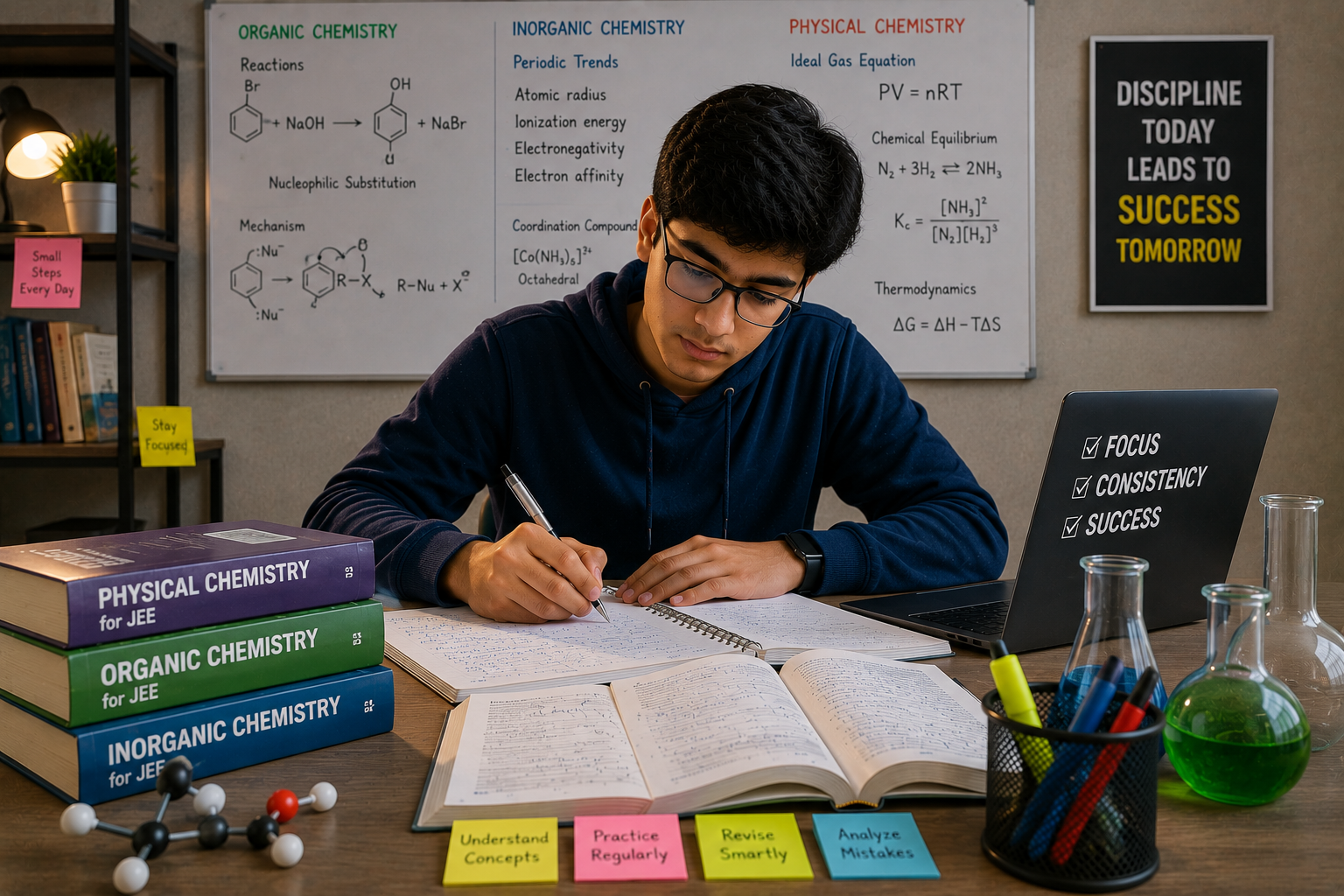
JEE Chemistry Preparation: Complete Strategy for JEE Main and JEE Advanced
Chemistry can be one of the most scoring subjects in JEE when prepared with the right strategy. However, many students make the mistake of treating the entire subject in the same way.
Chemistry has three major parts:
- Physical Chemistry
- Organic Chemistry
- Inorganic Chemistry
Each section requires a different preparation method.
Physical Chemistry requires conceptual understanding and numerical practice. Organic Chemistry requires understanding of reaction mechanisms and the relationship between different reactions. Inorganic Chemistry requires strong conceptual clarity along with regular revision and memorisation of important facts.
A successful JEE Chemistry preparation strategy can be summarised as:
Understand → Learn → Practise → Connect → Revise → Test → Improve
Instead of trying to memorise everything at once, divide your preparation according to the nature of each branch of Chemistry.
Why Is Chemistry Important for JEE?
Chemistry plays an important role in both JEE Main and JEE Advanced.
For many students, Chemistry can become a high-scoring subject because regular revision and systematic preparation can produce strong results.
However, the subject requires consistency.
A concept studied once and not revised for several months can easily be forgotten.
A good Chemistry preparation routine should include:
- Concept learning
- Regular revision
- Question practice
- Previous year questions
- Mistake analysis
The goal should be to maintain regular contact with all three branches of Chemistry.
Understand the Three Parts of JEE Chemistry
Before creating a preparation strategy, understand that Physical, Organic and Inorganic Chemistry should not be studied in exactly the same way.
Physical Chemistry
Focus on:
- Concepts
- Formulas
- Numerical problem-solving
- Units and calculations
Organic Chemistry
Focus on:
- Fundamental concepts
- Reaction mechanisms
- Electron movement
- Intermediates
- Reaction patterns
Inorganic Chemistry
Focus on:
- Periodic trends
- Chemical properties
- Important reactions
- Exceptions
- Regular revision
Using the correct strategy for each branch can make Chemistry much easier to manage.
How to Prepare Physical Chemistry for JEE
Physical Chemistry combines Chemistry concepts with mathematical problem-solving.
Important topics may include:
- Mole Concept
- Atomic Structure
- States of Matter
- Thermodynamics
- Thermochemistry
- Chemical Equilibrium
- Ionic Equilibrium
- Redox Reactions
- Solutions
- Electrochemistry
- Chemical Kinetics
The best approach to Physical Chemistry is:
Understand the Concept → Learn the Formula → Understand Its Application → Solve Numerical Questions
Step 1: Build Strong Fundamentals
Before solving difficult numerical questions, make sure you understand the basic concepts.
For example, in the Mole Concept, understand:
- Mole
- Molar mass
- Avogadro number
- Stoichiometry
- Limiting reagent
- Percentage composition
These fundamentals are used in many other Chemistry topics.
Do not move ahead if the basics are unclear.
Step 2: Understand the Formula Instead of Memorising It
Every formula should answer a question:
- What does this formula calculate?
- What does each variable represent?
- Under what conditions can it be used?
- What are the correct units?
Understanding these details helps prevent mistakes during problem-solving.
Step 3: Practise Numerical Questions Regularly
Physical Chemistry requires consistent numerical practice.
Start with:
- Basic concept questions
- Standard numerical problems
- Multi-step problems
- Advanced questions
- Previous year questions
Do not focus only on getting the correct answer.
Pay attention to the method.
If you make a mistake, identify whether it was caused by:
- Weak concepts
- Incorrect formula
- Calculation errors
- Unit conversion
- Misreading the question
How to Prepare Organic Chemistry for JEE
Organic Chemistry becomes much easier when you stop seeing it as a collection of separate reactions.
Instead, focus on understanding the logic behind reactions.
The foundation of Organic Chemistry includes:
- General Organic Chemistry
- Electronic effects
- Resonance
- Hyperconjugation
- Inductive effect
- Acidity and basicity
- Reaction intermediates
- Stability
- Nomenclature
- Isomerism
These topics form the base for advanced Organic Chemistry.
Understand Reaction Mechanisms
Instead of memorising every reaction separately, try to understand:
- Where electrons are moving
- Which atom acts as a nucleophile
- Which atom acts as an electrophile
- Which intermediate is formed
- Why a particular product is produced
Once you understand the mechanism, many reactions become easier to remember.
For example, instead of memorising ten reactions independently, identify the common pattern behind them.
This reduces unnecessary memorisation.
Create Reaction Maps
A useful Organic Chemistry strategy is to create reaction maps.
Connect:
Reactant → Reagent → Reaction Type → Product
Over time, you can build connections between different functional groups.
This makes revision easier because you begin seeing Organic Chemistry as an interconnected system rather than hundreds of unrelated reactions.
Practise Conversion Questions
Conversion questions are useful for improving your understanding of reactions.
When solving them:
- Identify the starting compound.
- Identify the required final product.
- Think about possible intermediate steps.
- Choose the appropriate reactions.
Do not immediately look at the answer.
Spend time planning the reaction pathway.
How to Prepare Inorganic Chemistry for JEE
Inorganic Chemistry requires a combination of understanding and regular revision.
Important areas may include:
- Periodic Table
- Chemical Bonding
- Coordination Compounds
- P-Block Elements
- D- and F-Block Elements
- Metallurgy
- Qualitative Analysis
The first step is to build conceptual understanding.
For example, do not simply memorise periodic trends.
Understand why:
- Atomic radius changes
- Ionisation energy changes
- Electronegativity changes
- Metallic character changes
Once the logic is clear, revision becomes easier.
Study Chemical Bonding Carefully
Chemical Bonding is one of the most important foundation chapters.
Focus on:
- Ionic bonding
- Covalent bonding
- Hybridisation
- Molecular orbital theory
- VSEPR theory
- Bond parameters
- Molecular geometry
A strong understanding of Chemical Bonding can help you in several other areas of Chemistry.
Use Active Revision for Inorganic Chemistry
Reading the same pages repeatedly is not always effective.
Try active revision methods.
For example:
- Close the book and recall important facts.
- Write important reactions from memory.
- Create short notes.
- Make flashcards for difficult information.
- Test yourself regularly.
Repeated active recall can help you retain important information.
How to Study NCERT for JEE Chemistry
NCERT should be studied carefully, especially for topics where direct factual understanding is important.
Do not just read quickly.
Pay attention to:
- Definitions
- Important statements
- Tables
- Reactions
- Examples
- Exceptions
- Diagrams
During revision, focus on areas where you frequently forget information.
Maintain short notes for important facts and exceptions.
How to Create Notes for JEE Chemistry
Your notes should help you revise quickly.
Avoid spending excessive time making decorative notes.
A useful Chemistry notebook can include:
Physical Chemistry
- Important formulas
- Conditions
- Common shortcuts
- Difficult numerical methods
Organic Chemistry
- Reaction mechanisms
- Important reagents
- Named reactions
- Conversion pathways
- Common exceptions
Inorganic Chemistry
- Important trends
- Reactions
- Colours
- Exceptions
- Key facts
Keep your notes concise.
The goal is fast revision before tests and examinations.
How to Practise Chemistry Questions
A good practice strategy should include different types of questions.
Level 1: Concept Questions
These test your basic understanding.
Level 2: Standard Questions
These test your ability to apply concepts.
Level 3: Mixed Questions
These involve multiple concepts.
Level 4: Advanced Questions
These require deeper understanding and analysis.
Do not begin with the most difficult questions.
Build your level gradually.
Previous Year Questions for JEE Chemistry
Previous year questions help you understand:
- The type of questions asked
- Important concepts
- Frequently tested areas
- Difficulty level
- Differences between JEE Main and JEE Advanced
After completing a chapter, solve relevant previous year questions.
Mark questions that are:
- Difficult
- Conceptually important
- Frequently based on a particular concept
- Questions where you made mistakes
Revisit these questions during revision.
How to Revise JEE Chemistry
Revision is especially important in Chemistry.
A useful revision cycle can include:
Daily Revision
Review recently studied concepts.
Weekly Revision
Revise the topics studied during the week.
Monthly Revision
Return to older chapters and test your recall.
Test-Based Revision
After every test, revise the concepts connected to your mistakes.
This prevents old chapters from becoming weak.
Maintain a Chemistry Error Notebook
Keep track of important mistakes.
Use a format like:
Topic → Mistake → Reason → Correct Concept
For example:
Topic: Chemical Equilibrium
Mistake: Applied the equilibrium constant expression incorrectly.
Reason: Included a pure solid in the expression.
Lesson: Review which substances are included in equilibrium expressions.
Over time, your error notebook can become a personalised revision resource.
How to Prepare Chemistry for JEE Main
For JEE Main, focus on:
- Strong understanding of fundamental concepts
- Important facts and reactions
- Formula recall
- Speed
- Accuracy
- Previous year questions
- Regular revision
Because time management is important, practise solving questions under timed conditions.
How to Prepare Chemistry for JEE Advanced
For JEE Advanced, focus more on:
- Deep conceptual understanding
- Multi-concept questions
- Complex numerical problems
- Reaction mechanisms
- Analytical thinking
- Advanced previous year questions
Do not rely only on memorised patterns.
Try to understand why the answer is correct.
JEE Advanced may present familiar concepts in unfamiliar ways.
Your conceptual foundation becomes extremely important in such situations.
Common Mistakes in JEE Chemistry Preparation
1. Studying All Three Branches in the Same Way
Physical, Organic and Inorganic Chemistry require different approaches.
2. Memorising Organic Reactions Without Understanding
Focus on mechanisms and reaction patterns.
3. Ignoring Inorganic Chemistry Until the End
Inorganic Chemistry requires repeated revision over time.
4. Avoiding Physical Chemistry Numericals
Regular practice is necessary to improve speed and accuracy.
5. Not Revising Regularly
Chemistry contains a large amount of information that can be forgotten.
6. Using Too Many Books
Select a limited number of reliable resources and complete them properly.
7. Ignoring Previous Year Questions
PYQs help you understand how concepts are tested.
8. Not Analysing Mistakes
Every mistake can reveal a weak area.
A Simple Weekly Chemistry Preparation Plan
During the Week
Focus on:
- Current chapters
- Theory and concepts
- Regular question practice
Try to maintain contact with all three branches.
Once or Twice a Week
Spend time on:
- Older chapters
- Important reactions
- Formula revision
- Weak areas
Weekend
Focus on:
- Chapter tests
- Previous year questions
- Mixed-topic practice
- Error analysis
- Revision
Adjust the schedule according to your school and coaching routine.
How to Balance Physical, Organic and Inorganic Chemistry
You do not need to study all three branches for exactly the same number of hours every day.
However, avoid ignoring one branch for a long period.
A balanced approach can include:
Physical Chemistry: Regular numerical practice
Organic Chemistry: Concept learning and reaction revision
Inorganic Chemistry: Short but frequent revision sessions
This keeps all three areas active.
Final Thoughts
JEE Chemistry preparation becomes much more manageable when you stop treating the entire subject as one type of subject.
Remember:
Physical Chemistry requires practice.
Organic Chemistry requires understanding and connections.
Inorganic Chemistry requires conceptual clarity and repeated revision.
Follow a structured cycle:
Learn → Understand → Practise → Revise → Test → Analyse
Do not try to memorise everything in one sitting or complete multiple books without proper revision.
Focus on building strong fundamentals, practising regularly and revisiting important information.
Over time, your understanding, recall speed and problem-solving ability will improve.
With consistent preparation and the right strategy for each branch, Chemistry can become one of the strongest and most scoring subjects in your JEE Main and JEE Advanced preparation.
