


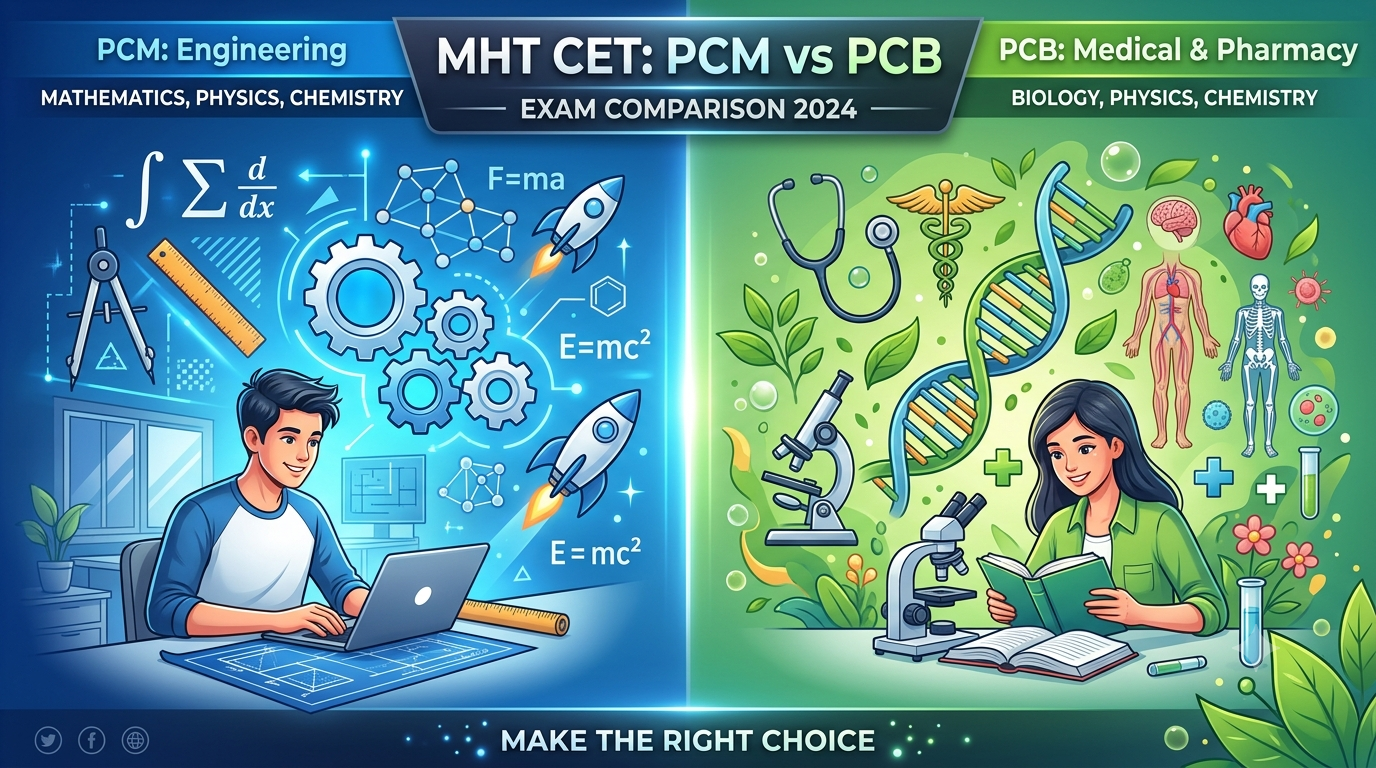
MHT CET PCM vs PCB: Difference, Subjects, Courses & Career Options
Choosing the right group for MHT CET is an important decision for students who have completed Class 12 Science. The Maharashtra Common Entrance Test (MHT CET) offers separate PCM (Physics, Chemistry, Mathematics) and PCB (Physics, Chemistry, Biology) groups, allowing students to pursue different undergraduate courses.
If you are confused about MHT CET PCM vs PCB, understanding the subjects, exam structure, eligibility pathways, and career options can help you make an informed choice.
What is MHT CET?
MHT CET is a state-level entrance examination conducted by the State Common Entrance Test Cell, Maharashtra, for admission to various professional undergraduate courses in Maharashtra. The official 2026 information brochure specifies separate PCM and PCB examinations. Candidates can choose PCM, PCB, or both, subject to the applicable rules.
The choice between PCM and PCB should primarily depend on your Class 12 subjects and the type of course you want to pursue after school.
MHT CET PCM vs PCB: Key Difference
The biggest difference between the two groups is the third subject:
| Feature | MHT CET PCM | MHT CET PCB |
|---|---|---|
| Subjects | Physics, Chemistry, Mathematics | Physics, Chemistry, Biology |
| Main focus | Mathematics and problem-solving | Biology and life sciences |
| Common pathways | Engineering, technology, planning and related courses | Pharmacy, agriculture and allied courses, among others |
| Suitable for students interested in | Engineering, technology, mathematics | Biology, healthcare, pharmacy and life sciences |
The official MHT CET brochure describes the papers as Physics, Chemistry and Mathematics OR Physics, Chemistry and Biology, with a total examination duration of 180 minutes.
MHT CET PCM: Subjects and Career Options
Students who enjoy mathematics, numerical problem-solving, physics and technology generally consider the PCM group.
The PCM group consists of:
- Physics
- Chemistry
- Mathematics
Depending on the course and admission requirements, PCM can be relevant for pathways such as B.E./B. Tech, B. Planning,g and other technical education programmes. The State CET Cell’s 2026 information brochure covers admissions to engineering and technology-related programmes through MHT CET.
After choosing PCM, students may explore fields such as:
- Computer Engineering
- Information Technology
- Mechanical Engineering
- Civil Engineering
- Electronics and Telecommunication
- Electrical Engineering
- Artificial Intelligence and related technology fields
- Planning and other technical programmes
Students interested in engineering should pay particular attention to Mathematics because it forms an important part of the PCM examination.
MHT CET PCB: Subjects and Career Options
The PCB group includes:
- Physics
- Chemistry
- Biology
PCB is generally considered by students who enjoy biology, human sciences, healthcare, pharmacy, agriculture, and related life-science fields.
Depending on eligibility and the admission route, PCB can be used for courses such as:
- Pharmacy
- Pharm.D
- Agriculture and allied sciences
- Other eligible biology-based undergraduate programmes
The Maharashtra CET Cell also publishes information for agriculture and allied courses where MHT CET PCM/PCB scores can be used as part of the admission process.
Students should always check the latest official eligibility criteria for their specific course before selecting an examination group.
Can You Appear for Both PCM and PCB?
Yes. Under the MHT CET 2026 rules, candidates can choose to appear for PCM, PCB, or both groups. The official brochure also states that marks obtained in one group are not transferred to the other group.
However, preparing for both groups means managing an additional subject and a broader syllabus. Students should therefore consider their target courses and preparation time before opting for both.
Which MHT CET Group Should You Choose?
Instead of choosing a group based only on what your friends are selecting, consider these questions:
Choose PCM if:
- You are comfortable with Mathematics.
- You enjoy numerical and logical problem-solving.
- You are interested in engineering or technology.
- You want to explore technical and computer-related fields.
Consider PCB if:
- Biology is one of your stronger subjects.
- You enjoy life sciences and healthcare-related subjects.
- You are interested in pharmacy, agriculture, or allied fields.
- You prefer studying biological concepts over advanced mathematical problem-solving.
Your preferred undergraduate course should be one of the biggest factors in deciding between PCM and PCB.
Prepare for MHT CET with the Right Guidance
MHT CET preparation requires consistent revision, conceptual understanding, regular practice, a nd effective time management. Students should combine textbook study with topic-wise practice, mock tests, and previous-question analysis.
If you are looking for structured guidance and classroom preparation, explore MHT CET Classes in Andheri at SchoolToppers. The right preparation strategy can help students build stronger concepts and approach the examination with greater confidence.
Final Thoughts
The choice between MHT CET PCM vs PCB ultimately depends on your academic strengths, Class 12 subjects,s and intended career pathway. PCM opens pathways primarily around mathematics, engineering and technology, while PCB can support pathways involving biology, pharmacy, agriculture and allied sciences.
Before finalising your choice, check the latest MHT CET brochure and the eligibility requirements of the specific undergraduate course you want to pursue. With the right subject combination and a consistent preparation plan, you can work towards your desired academic pathway.
