


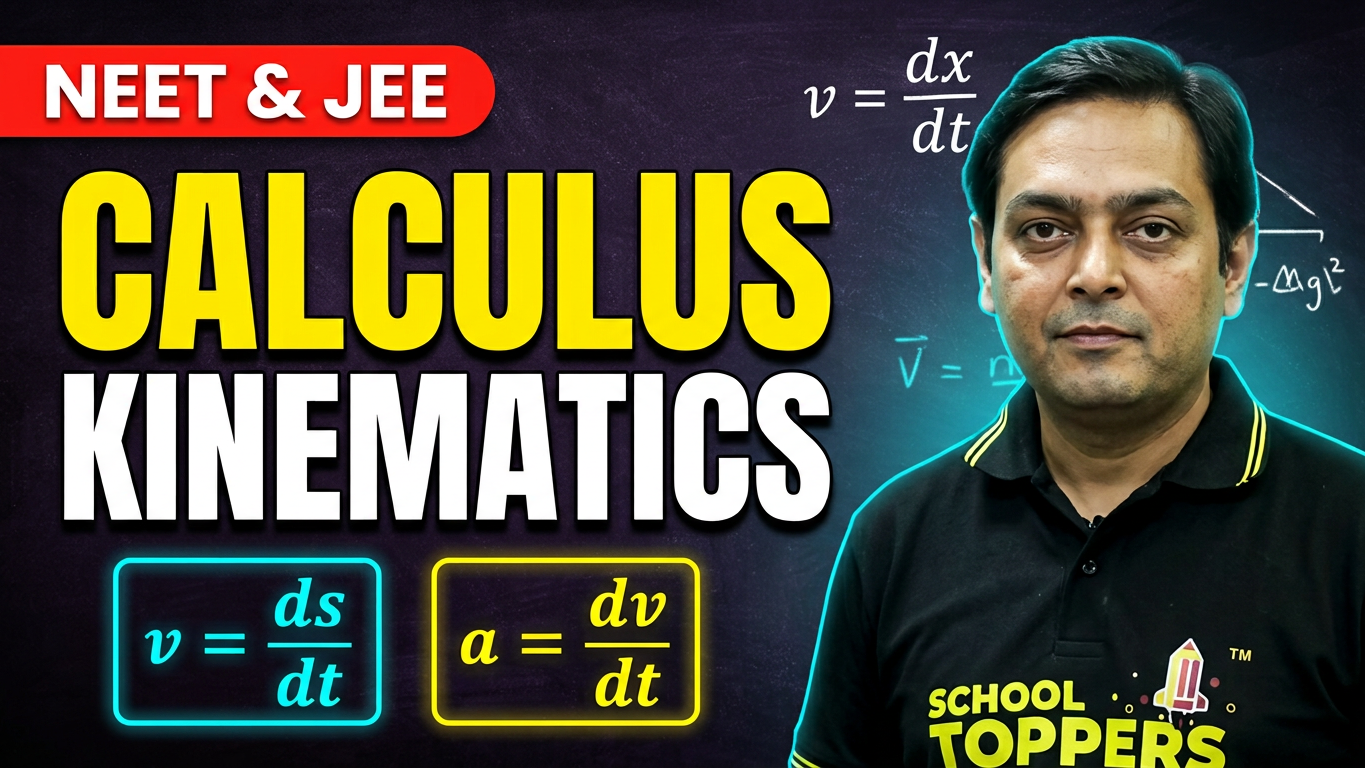
Mastering Calculus-Based Kinematics: Differentiation & Integration for NEET & JEE Physics
When starting your journey through Class 11 Physics, Kinematics is often one of the first major hurdles. While basic formulas for distance, displacement, and average velocity are easy to grasp, physics quickly transitions into a more advanced realm once time intervals approach zero. This is where Calculus-Based Kinematics comes into play.
If terms like differentiation and integration make you second-guess your physics problems, you aren’t alone. This foundational concept is critical for cracking competitive exams like NEET and JEE. Let’s break down how you can master calculus-based kinematics effortlessly.
Why Do We Need Calculus in Kinematics?
In everyday problems, we calculate average velocity over a given time interval ($\Delta t$). However, what happens when you need to find the instantaneous velocity—the exact speed of an object at an exact second (like the speed of a car at precisely 12:00 PM)?
Because the time interval shrinks to zero, standard division breaks down (division by zero is not possible). To solve this, physics borrows a powerful tool from mathematics: Calculus.
- Differentiation helps us move forward from position ($s$) to velocity ($v$), and velocity to acceleration ($a$).
- Integration helps us move backward from acceleration to velocity, and velocity to position.
Core Concepts Covered
1. Instantaneous Velocity and Acceleration via Differentiation
- Velocity ($v$): Defined as the rate of change of displacement with respect to time ($v = \frac{ds}{dt}$). By differentiating a position-time equation, you can easily find the velocity at any specific second.
- Acceleration ($a$): Defined as the rate of change of velocity ($a = \frac{dv}{dt}$). Differentiating the velocity equation gives you the acceleration function.
2. Going Backward Using Integration
Sometimes, instead of position, you are given an acceleration function and need to find the velocity or displacement. By applying definite integrals with appropriate initial conditions (limits), you can reverse the process to find how a particle’s motion evolves.
Watch the Full Step-by-Step Video Tutorial
Reading about calculus is one thing, but seeing it applied to numerical problems makes all the difference. In this detailed video lecture, we walk through multiple problem-solving examples—from simple 1D motion to multi-coordinate systems—so you can master these techniques step-by-step.
👉 Watch the video on YouTube: Calculus Based Kinematics: Differentiation & Integration for NEET & JEE | Class 11 Physics
Conclusion
Calculus is not just a math concept—it is the language of physics. Once you get comfortable applying basic power rules for differentiation and integration, kinematics problems become much easier to solve. Practice the examples covered in the video, keep your formulas handy, and you’ll be ready to ace your Class 11 physics exams!
