


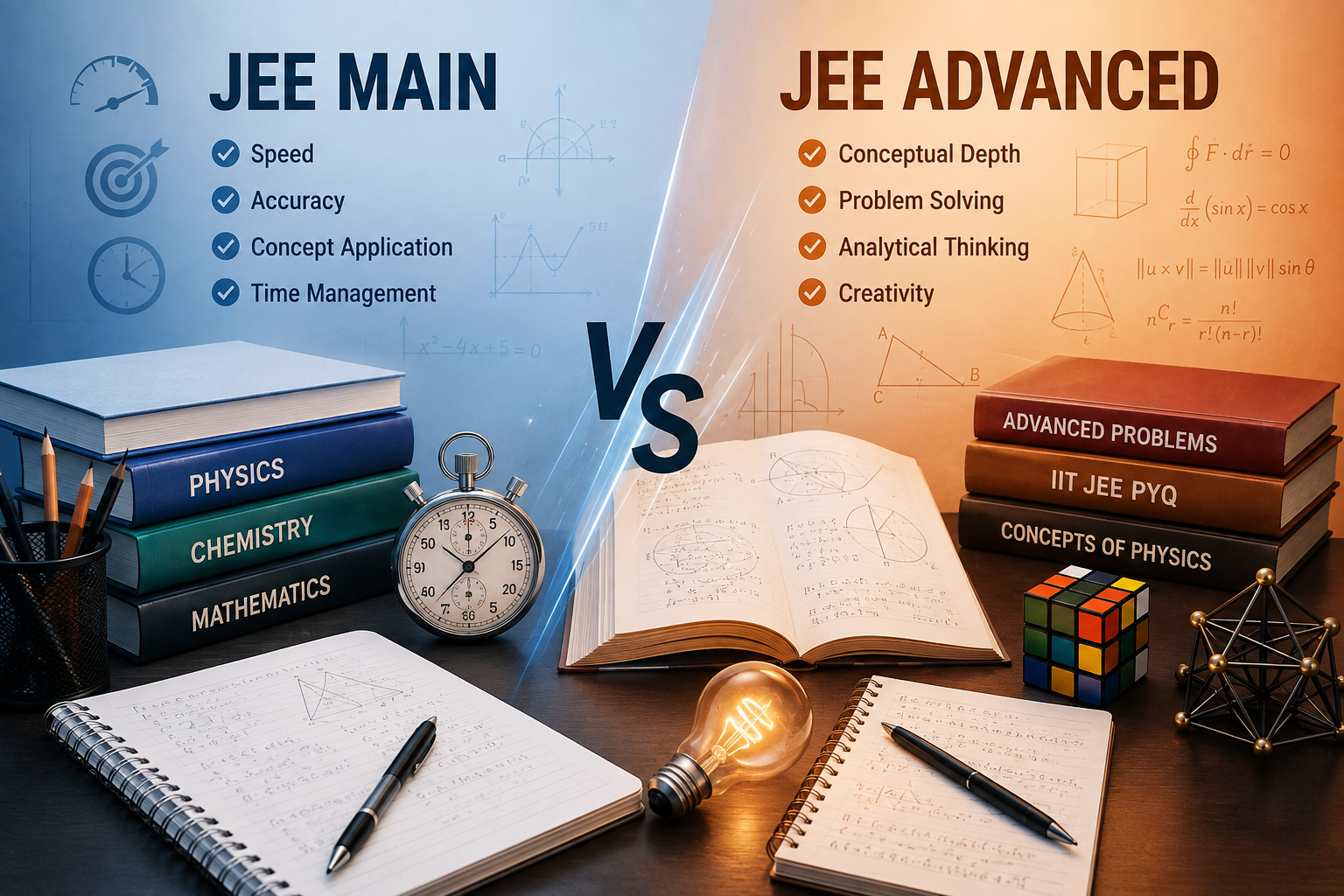
JEE Main vs JEE Advanced: Key Differences Every IIT Aspirant Should Know
For engineering aspirants in India, JEE Main and JEE Advanced are two of the most important entrance examinations. Although both are part of the journey towards studying engineering at some of India’s leading institutions, they are different in terms of eligibility, purpose, difficulty level, examination pattern, participating institutes and the type of preparation required.
Many students begin their JEE preparation without fully understanding the difference between JEE Main and JEE Advanced. As a result, they may either underestimate JEE Main or prepare for JEE Advanced using the wrong approach.
The simplest way to understand the relationship is:
JEE Main is the first major stage, while JEE Advanced is the gateway to admission into the IITs.
However, the difference goes much deeper than that.
This guide compares JEE Main vs JEE Advanced across eligibility, difficulty level, syllabus, exam pattern, question types, preparation strategy and career opportunities.
JEE Main vs JEE Advanced: Quick Comparison
| Feature | JEE Main | JEE Advanced |
|---|---|---|
| Purpose | Engineering entrance examination and qualifying stage for JEE Advanced | Entrance examination for admission to IITs |
| Conducting Authority | National-level examination authority | Conducted by an IIT on a rotational basis |
| Difficulty Level | Moderate to difficult | Highly challenging |
| Eligibility | Based on the official eligibility criteria | Only eligible top-performing candidates from JEE Main can appear |
| Number of Candidates | Very large number of aspirants | Limited to eligible candidates based on JEE Main performance |
| Question Style | More structured and speed-oriented | More analytical and unpredictable |
| Conceptual Depth | Strong understanding required | Very deep conceptual understanding required |
| Speed | Extremely important | Important, along with question selection |
| Accuracy | Important due to negative marking | Extremely important due to complex marking structures |
| Colleges | NITs, IIITs, other participating institutes and qualifying opportunities | IITs |
| Preparation Style | Concepts + speed + accuracy + PYQs | Deep concepts + advanced problem-solving + strategy |
What Is JEE Main?
JEE Main is one of India’s major engineering entrance examinations.
It serves multiple purposes, including admission opportunities to engineering institutions that consider JEE Main scores and qualification for the next stage of the IIT entrance process.
Students preparing for JEE Main are tested primarily on:
- Physics
- Chemistry
- Mathematics
The examination requires a strong understanding of the syllabus, regular question practice, time management and accuracy.
JEE Main can involve a large number of candidates, which makes consistent preparation extremely important.
A student does not need to solve every question in the most complicated way. Instead, success often depends on identifying questions that can be solved efficiently and avoiding unnecessary mistakes.
What Is JEE Advanced?
JEE Advanced is the examination associated with admission to the Indian Institutes of Technology, subject to the applicable eligibility criteria and admission process.
Only candidates who meet the required performance and eligibility conditions after JEE Main can appear for JEE Advanced.
JEE Advanced is known for testing more than just formula-based knowledge.
It can require students to:
- Connect multiple concepts.
- Analyse unfamiliar situations.
- Solve multi-step problems.
- Interpret complex questions carefully.
- Choose the right questions to attempt.
- Maintain concentration over long examination sessions.
The difficulty of JEE Advanced does not simply come from having a larger syllabus.
The major challenge is often how the concepts are tested.
A familiar concept can be presented in an unfamiliar way, requiring students to think beyond standard problem patterns.
JEE Main vs JEE Advanced: Eligibility
One of the biggest differences between the two examinations is the eligibility process.
JEE Main Eligibility
Students need to meet the eligibility requirements specified in the official information bulletin for the relevant examination year.
The criteria can include factors such as:
- Academic qualification.
- Year of passing.
- Subject requirements.
- Attempt limits or other applicable conditions.
Candidates should always check the latest official eligibility requirements before applying.
JEE Advanced Eligibility
Appearing for JEE Advanced involves an additional qualification stage.
Generally, candidates first need to meet the required performance criteria in JEE Main and then satisfy the official JEE Advanced eligibility requirements.
The exact rules can include conditions related to:
- JEE Main performance.
- Category-based eligibility where applicable.
- Age or attempt limits where applicable.
- Academic qualification.
- Other conditions specified for that year.
Because eligibility rules can change, students should always refer to the official information bulletin for the year in which they plan to appear.
JEE Main vs JEE Advanced: Difficulty Level
The difference in difficulty is one of the most commonly discussed aspects.
However, simply saying that JEE Advanced is “harder” does not explain the complete difference.
JEE Main Difficulty
JEE Main requires:
- Good conceptual understanding.
- Fast problem-solving.
- Strong calculation skills.
- Efficient time management.
- Accuracy.
Students need to move quickly through the paper and avoid spending too much time on individual questions.
A good score often depends on balancing:
Speed + Accuracy + Question Selection
JEE Advanced Difficulty
JEE Advanced usually demands a higher level of analytical thinking.
Questions can:
- Combine multiple concepts.
- Have unusual structures.
- Require deeper reasoning.
- Include multiple correct possibilities depending on the question format.
- Test whether students truly understand a concept.
You may spend several minutes simply understanding how to approach a problem.
This means the strategy is not:
Solve everything as quickly as possible.
Instead, it is often:
Identify the right questions → Understand the problem → Apply the right concepts → Solve accurately.
JEE Main vs JEE Advanced: Exam Pattern
The examination patterns of JEE Main and JEE Advanced are different.
JEE Main Exam Pattern
JEE Main generally follows a more defined examination structure.
Students are tested across:
- Physics
- Chemistry
- Mathematics
The exam requires students to manage time efficiently across all three subjects.
The exact question format, marking scheme, number of questions and examination structure should always be checked for the relevant examination year.
JEE Advanced Exam Pattern
JEE Advanced is known for having a more dynamic and challenging examination structure.
The pattern may involve:
- Different types of multiple-choice questions.
- Numerical or integer-based questions.
- Multiple-correct-answer questions.
- Questions with varying marking schemes.
- Subject-specific sections.
- Multiple examination papers.
Students should carefully study the official pattern and instructions for their examination year.
One important difference is that JEE Advanced preparation requires students to become comfortable with different question formats.
You should not rely only on one type of practice question.
JEE Main vs JEE Advanced: Syllabus
The Physics, Chemistry and Mathematics topics studied for JEE Main and JEE Advanced have significant overlap.
However, the major difference lies in the depth of understanding and application.
For example, a topic may be studied at a level sufficient for JEE Main, but JEE Advanced can test the same topic using:
- Multiple concepts.
- Unusual conditions.
- Complex calculations.
- Deeper reasoning.
Therefore, students preparing for both examinations should not think of them as completely separate subjects.
Instead, think of your preparation in levels.
Level 1: Foundation
Understand the basic theory.
Level 2: JEE Main Level
Practise standard applications and improve speed.
Level 3: JEE Advanced Level
Solve complex, multi-concept and unfamiliar problems.
This progression allows you to build naturally instead of trying to jump directly to advanced questions.
JEE Main vs JEE Advanced: Question Types
The style of questions is one of the most important differences.
JEE Main Questions
Questions often require students to:
- Apply a concept.
- Use the correct formula.
- Perform calculations efficiently.
- Select the correct answer.
- Solve within limited time.
The challenge often comes from maintaining accuracy while working quickly.
JEE Advanced Questions
Questions can require:
- Deep analysis.
- Combining concepts.
- Identifying hidden relationships.
- Considering multiple possibilities.
- Using creative problem-solving.
A student may know all the formulas required but still struggle if they cannot identify the correct approach.
This is why JEE Advanced preparation should include exposure to unfamiliar and high-quality problems.
JEE Main vs JEE Advanced: Physics Preparation
The preparation approach for Physics changes depending on your target examination.
For JEE Main
Focus on:
- Strong concepts.
- Formula application.
- Numerical practice.
- PYQs.
- Speed and accuracy.
You should learn to recognise the concept being tested quickly.
For JEE Advanced
Go deeper.
Focus on:
- Fundamental principles.
- Derivations and assumptions where useful.
- Multi-concept problems.
- Alternative approaches.
- Visualisation.
- Advanced numerical questions.
Instead of asking only:
Which formula should I use?
Ask:
Which physical principle explains this situation?
This change in thinking can significantly improve your advanced problem-solving ability.
JEE Main vs JEE Advanced: Chemistry Preparation
Chemistry preparation also requires a different level of depth.
For JEE Main
Focus strongly on:
- NCERT concepts and information.
- Important formulas.
- Reactions.
- Regular revision.
- PYQs.
Speed and memory recall can play an important role.
For JEE Advanced
You need greater conceptual depth.
Physical Chemistry
Focus on understanding the principles behind equations and solving complex numerical problems.
Organic Chemistry
Focus on:
- Mechanisms.
- Electron movement.
- Reaction intermediates.
- Stability.
- Functional group behaviour.
Inorganic Chemistry
Focus on:
- Core concepts.
- Trends.
- Exceptions.
- Important reactions.
- Detailed revision.
The goal should be understanding plus retention.
JEE Main vs JEE Advanced: Mathematics Preparation
Mathematics is challenging in both examinations but the nature of the challenge can differ.
JEE Main Mathematics
Requires:
- Formula knowledge.
- Speed.
- Accuracy.
- Familiarity with different question types.
Students need to avoid spending too much time on one difficult problem.
JEE Advanced Mathematics
Requires deeper analytical ability.
Questions may:
- Combine different chapters.
- Require an unexpected observation.
- Have multiple solution paths.
- Test conceptual understanding rather than direct formula application.
For JEE Advanced Mathematics, spending time understanding difficult problems can be highly valuable.
However, you should also learn when to leave a question during the actual examination.
JEE Main vs JEE Advanced: Preparation Strategy
Your preparation strategy should change as you progress.
JEE Main Preparation Strategy
A typical preparation cycle is:
Learn Concepts → Practise Questions → Solve PYQs → Take Mock Tests → Analyse → Revise
Focus heavily on:
- Completing the syllabus.
- Improving speed.
- Reducing silly mistakes.
- Practising previous year questions.
- Taking regular mock tests.
The ability to identify and solve questions efficiently is extremely important.
JEE Advanced Preparation Strategy
The cycle should focus more on depth:
Learn Concepts → Build Fundamentals → Solve Advanced Problems → Analyse Approaches → Solve PYQs → Take Mock Tests → Revise
Focus on:
- Deep conceptual clarity.
- High-quality problems.
- Multi-concept questions.
- Error analysis.
- Question selection.
- Mental stamina.
You should learn not only how to solve a question, but also how to think about a difficult question.
Can You Prepare for JEE Main and JEE Advanced Together?
Yes. In fact, many students prepare for both examinations simultaneously.
The best approach is to build a strong foundation and gradually increase the level of problem-solving.
For each chapter:
Step 1: Learn the concept
Understand the theory properly.
Step 2: Solve basic problems
Make sure the fundamentals are clear.
Step 3: Practise JEE Main-level questions
Improve speed and standard application.
Step 4: Solve advanced problems
Challenge yourself with multi-concept and unfamiliar questions.
Step 5: Solve PYQs
Understand how the actual examinations test the topic.
This layered approach prevents you from treating JEE Main and JEE Advanced as two completely unrelated preparation journeys.
Which Exam Should You Focus On First?
For students targeting IITs, both examinations are important.
However, the immediate focus may depend on your preparation stage.
If you are in the early stages of preparation, focus on building:
- Strong fundamentals.
- Complete syllabus coverage.
- Problem-solving habits.
If you have already built a good foundation, gradually increase exposure to advanced-level problems.
If JEE Main is approaching, give appropriate attention to:
- Speed.
- Accuracy.
- Mock tests.
- PYQs.
- Exam strategy.
After the JEE Main stage, eligible students can shift their focus more heavily towards:
- Advanced-level problem-solving.
- Full-length JEE Advanced mock tests.
- Deep revision.
- Question selection.
JEE Main vs JEE Advanced: Colleges and Opportunities
JEE Main can provide opportunities for admission to institutions and programmes that use JEE Main scores, including NITs, IIITs and other participating institutions, depending on the applicable counselling and admission rules.
JEE Advanced is associated with admission opportunities to undergraduate programmes at the Indian Institutes of Technology through the applicable counselling and admission process.
The final institute and programme depend on several factors, including:
- Rank.
- Category, where applicable.
- Seat availability.
- Programme preferences.
- Counselling rules.
Students should always check the latest official admission and counselling information.
Which Is Harder: JEE Main or JEE Advanced?
In terms of conceptual depth and problem-solving complexity, JEE Advanced is generally considered more challenging.
However, this does not mean JEE Main is easy.
JEE Main also presents significant challenges because of:
- Large competition.
- Extensive syllabus.
- Time pressure.
- Negative marking where applicable.
- The need for speed and accuracy.
The two examinations test slightly different skills.
JEE Main tests:
How efficiently can you apply your knowledge?
JEE Advanced tests:
How deeply do you understand your knowledge, and how effectively can you apply it in unfamiliar situations?
Both require serious and disciplined preparation.
Common Mistakes Students Make While Preparing for Both Exams
1. Ignoring JEE Main while focusing only on JEE Advanced
JEE Main is an important stage in the overall journey and should not be taken lightly.
2. Preparing only with basic questions
Basic questions are necessary for building foundations, but advanced aspirants also need exposure to challenging problems.
3. Starting difficult books too early
First build strong fundamentals.
Difficulty without understanding can lead to frustration.
4. Ignoring speed
Even advanced preparation requires efficient time management.
5. Ignoring previous year questions
PYQs help you understand both examination styles.
6. Taking mock tests without analysing them
Your score alone does not explain your weaknesses.
Analyse:
- Incorrect questions.
- Unattempted questions.
- Time-consuming questions.
- Repeated mistakes.
7. Using too many resources
Choose reliable resources and complete them properly.
Depth is better than collecting endless material.
How to Build the Right Strategy for Both JEE Main and JEE Advanced
A balanced long-term strategy can look like this:
Phase 1: Build Fundamentals
Focus on concepts and basic problem-solving.
Phase 2: Strengthen JEE Main Skills
Improve speed, accuracy and familiarity with standard question types.
Phase 3: Develop Advanced Problem-Solving
Solve difficult and multi-concept problems.
Phase 4: Practise PYQs
Understand how concepts are tested in actual examinations.
Phase 5: Take Mock Tests
Build exam temperament and improve strategy.
Phase 6: Revise Continuously
Use:
- Formula sheets.
- Short notes.
- Error notebooks.
- Important questions.
- Chapter summaries.
This approach allows you to progress from foundation-level learning to competitive problem-solving.
Final Comparison: JEE Main vs JEE Advanced
The key difference can be summarised simply:
JEE Main requires you to be fast, accurate and conceptually strong.
JEE Advanced requires you to think deeply, analyse unfamiliar problems and apply concepts creatively.
Neither examination should be underestimated.
A strong student does not need to prepare for them as completely separate journeys. Instead, build your preparation step by step.
Start with the fundamentals.
Strengthen your concepts.
Practise standard problems.
Improve your speed.
Then challenge yourself with advanced and unfamiliar questions.
Solve previous year questions, take mock tests, analyse your mistakes and revise consistently.
The most effective preparation path is:
Strong Foundation → JEE Main-Level Practice → Advanced Problem-Solving → PYQs → Mock Tests → Revision
With the right strategy, JEE Main can become a strong foundation for your next stage of preparation, while advanced-level practice can help you develop the deeper problem-solving skills required to perform at your best.
