


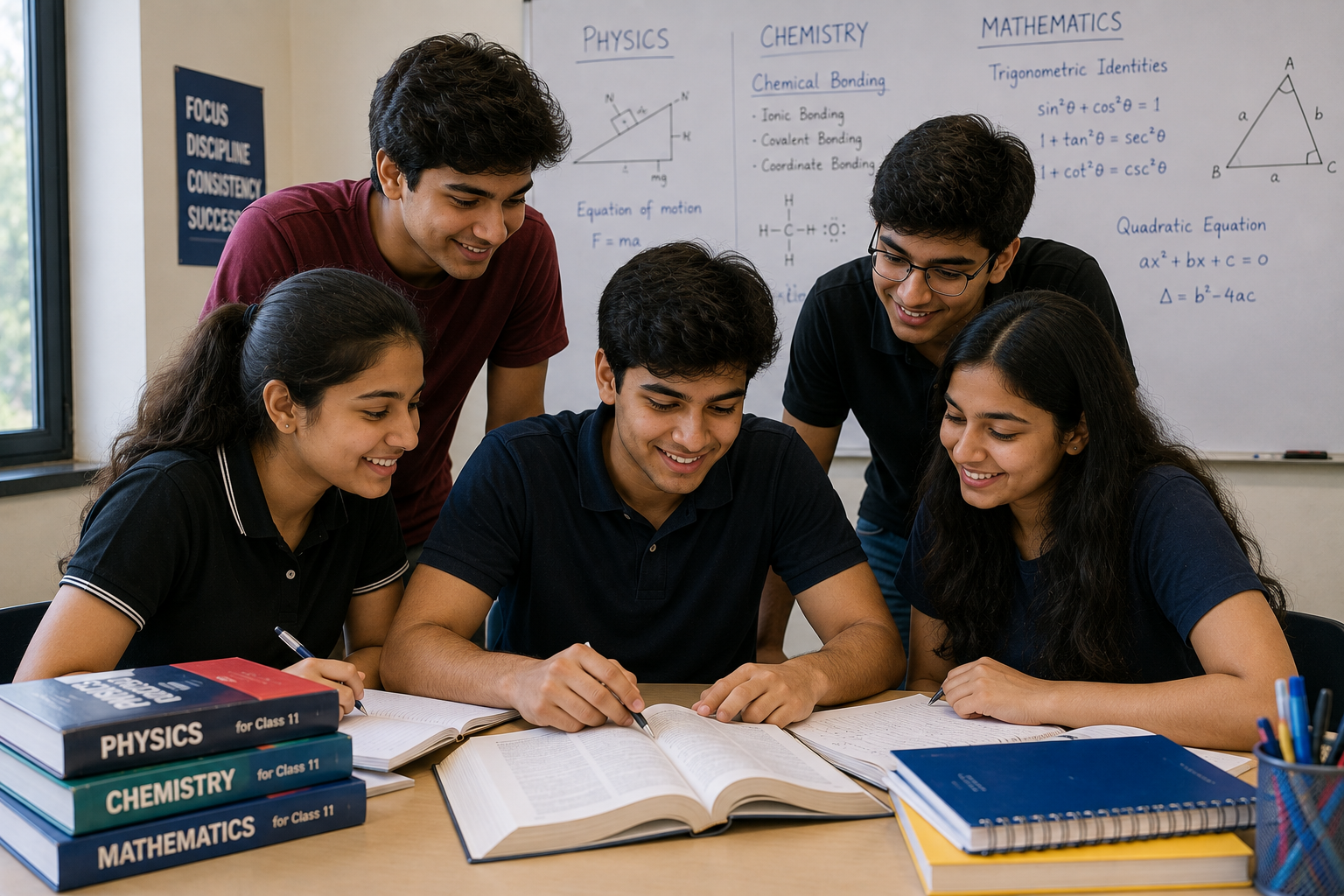
How to Prepare for JEE from Class 11: A Complete Two-Year Preparation Strategy
Starting JEE preparation from Class 11 gives students a valuable advantage: time.
You have approximately two years to build concepts, practise questions, identify weaknesses, revise the syllabus and prepare for JEE Main and JEE Advanced. However, having two years does not automatically make preparation easy. Class 11 introduces a completely new level of Physics, Chemistry and Mathematics, and many students struggle because they underestimate the difficulty of the transition.
The key is to start with the right approach.
You do not need to study for extremely long hours from day one. You need a structured system that helps you understand concepts, practise regularly and avoid backlogs.
A strong two-year JEE preparation journey can be summarised as:
Learn → Understand → Practise → Analyse → Revise → Improve
This article explains how to prepare for JEE from Class 11, how to manage Class 11 and Class 12 together, how to avoid common mistakes and how to build a realistic long-term strategy.
Why Is Class 11 Important for JEE Preparation?
Class 11 is the foundation of your JEE preparation.
Many important topics introduced in Class 11 are connected to Class 12 chapters. If your fundamentals are weak in Class 11, you may face difficulties later.
For example:
In Physics, concepts such as:
- Kinematics
- Laws of Motion
- Work, Energy and Power
- Circular Motion
- Rotational Motion
help develop the problem-solving foundation required for advanced topics.
In Chemistry, chapters such as:
- Mole Concept
- Atomic Structure
- Chemical Bonding
- Thermodynamics
- Equilibrium
- General Organic Chemistry
form the base for several Class 12 topics.
In Mathematics, Class 11 concepts such as:
- Functions
- Trigonometry
- Quadratic Equations
- Sequences and Series
- Coordinate Geometry
become useful throughout your JEE preparation.
This is why Class 11 should not be treated casually.
The Biggest Challenge of Starting JEE in Class 11
The transition from Class 10 to Class 11 can feel difficult.
In Class 10, students are often able to perform well by understanding the textbook and practising standard questions.
JEE preparation requires a deeper level of thinking.
You may encounter questions where:
- The correct formula is not immediately obvious.
- Multiple concepts are involved.
- The problem takes several steps to solve.
- The question looks unfamiliar.
- You need to decide which approach to use.
Initially, struggling with difficult questions is completely normal.
The goal is not to solve every difficult problem immediately.
The goal is to gradually develop the ability to think through complex problems.
Step 1: Start With Strong Fundamentals
When you begin a new chapter, do not immediately jump to difficult questions.
First understand:
- Basic definitions
- Important concepts
- Formula derivations
- Conditions for applying formulas
- Common applications
- Connections between concepts
For example, in Physics, do not memorise an equation without understanding what each variable represents.
In Mathematics, do not memorise a method without understanding why it works.
In Chemistry, do not memorise reactions without understanding the concepts behind them.
Strong fundamentals make advanced problem-solving much easier.
Step 2: Follow the Right Learning Sequence
A useful chapter preparation process is:
Learn the Theory
Attend your classes or study from a reliable source.
Focus on understanding instead of simply writing notes.
Review the Concept
After the class, spend time revising what you learned.
Try to explain the concept in your own words.
If you cannot explain it clearly, you may not fully understand it yet.
Solve Basic Questions
Start with simple problems.
This helps you understand how concepts are applied.
Move to Moderate Questions
Once your basics are strong, solve questions that require more thinking.
Attempt Advanced Problems
Gradually move towards difficult and multi-concept questions.
Do not start with the hardest questions on the first day.
Review Mistakes
Understand why you made an error.
Was it because of:
- A weak concept?
- A calculation mistake?
- Misreading the question?
- Choosing the wrong approach?
- Lack of practice?
This analysis is extremely important.
Step 3: Never Let Backlogs Build Up
One of the biggest dangers during Class 11 is backlog.
A student may miss one chapter and decide to complete it later.
Then another chapter begins.
After a few weeks, several topics remain incomplete.
Eventually, the backlog becomes overwhelming.
The best solution is to clear doubts and pending topics quickly.
If you fall behind, do not panic.
Create a recovery plan.
For example:
- Continue with your current classes.
- Dedicate a small amount of additional time to backlog topics.
- Break large chapters into smaller sections.
- Set realistic weekly targets.
- Avoid postponing the same chapter repeatedly.
Do not stop your current preparation to complete every old topic first.
Try to balance current studies with backlog recovery.
Step 4: Create a Realistic Daily Study Routine
There is no universal timetable that works for every JEE aspirant.
Your schedule depends on:
- School timing
- Coaching schedule
- Travel time
- Current preparation level
- Strengths and weaknesses
Instead of copying someone else’s 14-hour study timetable, create a routine that you can follow consistently.
A productive study day can include:
- Learning new concepts
- Revising previous topics
- Solving questions
- Reviewing mistakes
For example, outside school or coaching hours, you can divide your study time between:
Current Topics
Revise what was taught recently and complete related practice.
Previous Topics
Spend time revising older chapters so they are not forgotten.
Weak Areas
Dedicate some time to concepts where you repeatedly struggle.
Consistency matters more than following an unrealistic schedule for a few days.
Step 5: Give Equal Attention to Physics, Chemistry and Mathematics
Many students naturally prefer one subject.
Some enjoy Mathematics but avoid Chemistry.
Others focus heavily on Physics and ignore Mathematics.
This can create problems later.
JEE requires preparation in all three subjects.
Try to maintain regular contact with:
- Physics
- Chemistry
- Mathematics
You do not necessarily need to spend exactly the same amount of time on every subject.
If one subject is weaker, it may require additional attention.
The goal is to prevent any subject from becoming a major weakness.
How to Prepare Physics in Class 11 for JEE
Class 11 Physics forms a major foundation for JEE preparation.
Important areas include:
- Units and Measurements
- Kinematics
- Laws of Motion
- Work, Energy and Power
- Centre of Mass
- Rotational Motion
- Gravitation
- Properties of Matter
- Thermodynamics
- Oscillations
- Waves
A good Physics strategy is:
Understand the Situation → Draw It → Identify the Concept → Apply the Principle → Solve
When solving problems:
- Draw diagrams where useful.
- Write down known quantities.
- Identify what needs to be found.
- Think about the physical principle involved.
- Check whether your final answer makes sense.
Do not simply search for a formula.
Try to understand the physics behind the question.
How to Prepare Chemistry in Class 11 for JEE
Chemistry should be divided into three parts:
Physical Chemistry
Physical Chemistry requires:
- Strong concepts
- Formula understanding
- Numerical practice
Important Class 11 areas include:
- Mole Concept
- Atomic Structure
- States of Matter
- Thermodynamics
- Equilibrium
- Redox Reactions
The best approach is to understand the concept first and then practise numerical questions.
Organic Chemistry
Organic Chemistry should not be treated as a list of reactions to memorise.
Focus on:
- Basic Organic Chemistry
- Electronic effects
- Reaction intermediates
- Stability
- Reaction mechanisms
A strong understanding of General Organic Chemistry can make future topics easier.
Inorganic Chemistry
For Inorganic Chemistry:
- Understand periodic trends.
- Study chemical bonding carefully.
- Revise important facts regularly.
- Maintain short notes for exceptions and important information.
Regular revision is important because factual information can be forgotten over time.
How to Prepare Mathematics in Class 11 for JEE
Mathematics requires consistent practice.
Important Class 11 topics include:
- Sets
- Relations and Functions
- Trigonometry
- Complex Numbers
- Quadratic Equations
- Permutations and Combinations
- Binomial Theorem
- Sequences and Series
- Straight Lines
- Circles
- Conic Sections
- Probability
The best way to improve in Mathematics is to solve problems regularly.
When you encounter a difficult problem:
- Read it carefully.
- Identify the topic.
- Try different approaches.
- Spend time thinking.
- Look at the solution only after making a genuine attempt.
- Close the solution and try again.
Do not depend on memorising solutions.
Focus on understanding the thought process.
Step 6: Start Revision From the Beginning
Do not wait until Class 12 to revise Class 11.
A good revision cycle can include:
Daily Revision
Review recently studied concepts.
Weekly Revision
Revise important topics from the week.
Monthly Revision
Revisit older chapters and solve selected questions.
Major Revision
After completing a group of chapters, take a test and identify weak areas.
Regular revision prevents completed chapters from disappearing from memory.
Step 7: Solve Previous Year Questions
Previous year questions should become part of your preparation once you have developed a reasonable understanding of the chapter.
PYQs help you understand:
- The type of questions asked.
- The depth of concepts required.
- Frequently tested areas.
- Your preparation level.
- The difference between JEE Main and JEE Advanced.
A useful approach is:
Complete Chapter → Practise Questions → Solve PYQs → Analyse Mistakes → Revise
Do not simply check the answer.
Try to understand why the correct approach works.
Step 8: Take Regular Tests
Tests are not only used to measure your score.
They are a learning tool.
Start with:
- Topic-wise tests
- Chapter-wise tests
- Part-syllabus tests
- Full-syllabus tests later in your preparation
After every test, analyse:
- Incorrect questions
- Unattempted questions
- Calculation mistakes
- Conceptual gaps
- Questions where you wasted time
- Questions you misread
Your mistakes can help you improve if you analyse them properly.
Maintain an Error Notebook
An error notebook can become one of your most useful revision tools.
Whenever you make an important mistake, write:
Topic → Mistake → Why It Happened → Correct Method → Lesson
For example:
Topic: Laws of Motion
Mistake: Forgot to include friction while drawing the force diagram.
Reason: Started calculating before analysing all the forces.
Lesson: Always draw a complete free-body diagram first.
Over time, you may identify repeated patterns.
This allows you to fix the actual cause of your mistakes.
Step 9: Balance School and JEE Preparation
You should not completely ignore school studies.
Fortunately, many Class 11 topics overlap with JEE preparation.
The difference is the level of understanding and problem-solving required.
A good approach is to study the core concept properly once and then practise questions at different levels.
For example:
Understand the Chapter → Prepare for School → Practise JEE-Level Questions → Revise
This can reduce unnecessary repetition.
How to Prepare During School Exams
During school examination periods, you may need to adjust your routine.
Do not completely abandon JEE preparation.
Instead:
- Focus on school exam requirements.
- Continue light revision of JEE concepts.
- Solve a few questions regularly.
- Resume your normal JEE schedule after the examination.
The goal is to maintain continuity.
Step 10: Use Limited and Reliable Study Resources
One of the biggest mistakes is collecting too many books.
You do not need five resources for every chapter.
Choose:
- Your school or coaching material
- NCERT
- One reliable practice resource where required
- Previous year questions
- Mock tests
The goal should be to complete and revise your selected resources.
A half-completed collection of ten books is less useful than a few resources studied properly.
A Simple Weekly Plan for Class 11 JEE Preparation
Here is a practical structure.
Monday to Friday
Focus on:
- Current topics
- Daily revision
- Question practice
- Clearing doubts
Saturday
Use the day for:
- Backlog recovery
- Difficult questions
- Weak topics
- Additional practice
Sunday
Focus on:
- Weekly revision
- Chapter test or mixed test
- Test analysis
- Planning the next week
You can adjust this based on your school and coaching schedule.
Common Mistakes Class 11 Students Should Avoid
1. Taking Class 11 Lightly
Class 11 chapters form an important foundation for JEE.
Do not assume you can complete everything later.
2. Allowing Backlogs to Grow
Clear pending topics before they become overwhelming.
3. Starting Too Many Books
Use a limited number of quality resources.
4. Solving Questions Without Understanding Theory
Problem practice is important, but concepts must come first.
5. Ignoring Revision
Without revision, previously completed chapters will gradually become weak.
6. Comparing Your Progress With Others
Every student learns at a different speed.
Focus on improving your own preparation.
7. Studying Only Your Favourite Subject
Maintain regular practice across Physics, Chemistry and Mathematics.
8. Taking Tests Without Analysing Them
A test score is useful, but the mistakes behind the score are even more important.
9. Sacrificing Sleep and Health
Long-term preparation requires consistency.
A tired and exhausted student cannot maintain productive study for two years.
Make time for:
- Proper sleep
- Physical activity
- Healthy meals
- Short breaks
What Should You Achieve by the End of Class 11?
By the end of Class 11, aim to have:
- A strong understanding of major Class 11 concepts.
- Most Class 11 chapters completed.
- Regular question practice completed.
- Important formulas and concepts revised.
- Previous year questions solved for completed chapters.
- Weak areas identified.
- An error notebook.
- A consistent revision habit.
- Experience with chapter and part-syllabus tests.
You do not need to be perfect in every chapter.
The goal is to enter Class 12 with a strong foundation and without a massive Class 11 backlog.
How to Transition From Class 11 to Class 12
When Class 12 begins, do not completely forget Class 11.
Continue revising older chapters regularly.
A good strategy is:
Class 12 Current Topics + Class 11 Weekly Revision
For example, spend most of your time on current Class 12 topics while dedicating a smaller but consistent portion of your schedule to Class 11 revision.
This prevents Class 11 concepts from becoming weak.
Final Thoughts
Preparing for JEE from Class 11 is not about studying continuously for two years without rest.
It is about building a sustainable system.
Focus on:
Strong Concepts → Consistent Practice → Regular Revision → Mock Tests → Mistake Analysis
The biggest advantage of starting from Class 11 is that you have time to learn properly.
Use that time wisely.
Do not rush through chapters just to say that the syllabus is complete. Make sure you understand the concepts, solve questions independently and revisit important topics regularly.
You will make mistakes.
Some chapters will take longer than expected.
Some tests may not go well.
That is a normal part of the preparation process.
The students who improve consistently are usually not the ones who never struggle. They are the ones who identify their weaknesses, correct their mistakes and continue moving forward.
If you stay consistent throughout Class 11 and avoid allowing backlogs to build up, you can enter Class 12 with a strong foundation and a much clearer path towards JEE Main and JEE Advanced.
