


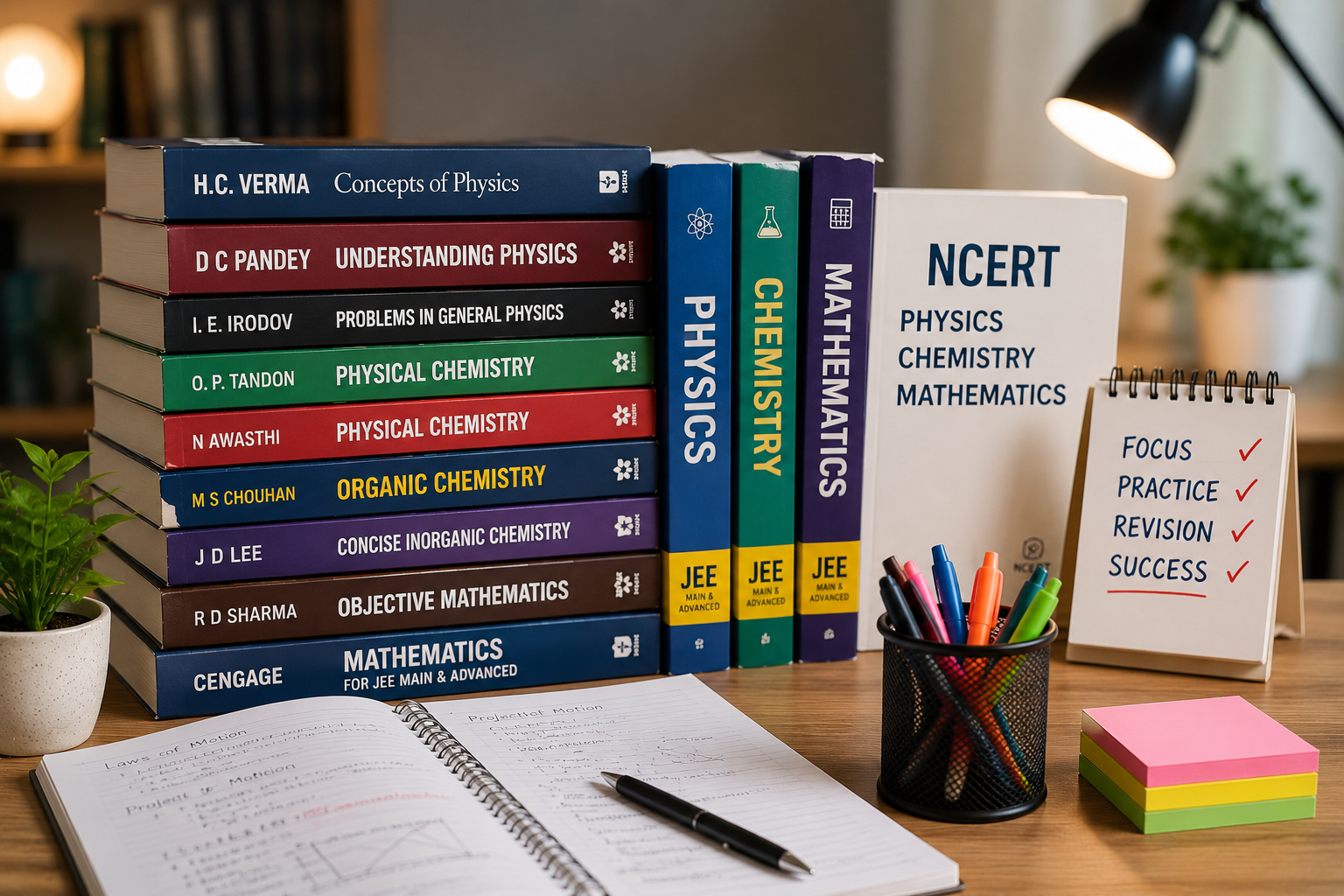
Best Books for JEE: Subject-Wise Book Recommendations for JEE Main and JEE Advanced
Choosing the best books for JEE preparation can be confusing. Walk into a bookstore or search online, and you will find dozens of books for Physics, Chemistry and Mathematics. Many students make the mistake of buying too many books and trying to solve everything.
The truth is, you do not need a huge collection of books to prepare well for JEE.
What matters more is choosing the right resources and using them properly.
A good JEE preparation strategy should include:
- NCERT textbooks
- One reliable concept-building resource
- One good problem-solving resource
- Previous year questions
- Regular mock tests
- Revision notes
The best book for one student may not always be the best for another. Your choice should depend on your current level, target exam and how strong your fundamentals are.
This guide covers some of the most commonly recommended books for JEE Main and JEE Advanced preparation, subject by subject.
How Many Books Do You Need for JEE Preparation?
Before looking at individual books, it is important to understand one thing: more books do not automatically mean better preparation.
A common mistake is collecting five different books for every subject.
For example, a student may study one chapter from one book, switch to another book for questions and then move to a third resource because someone else recommended it.
This often leads to incomplete preparation.
A better approach is:
Learn Concepts → Practise Questions → Solve Previous Year Questions → Take Mock Tests → Revise
For most students, a limited number of good resources is enough when used consistently.
Best Books for JEE Physics
Physics requires strong conceptual understanding along with problem-solving ability. You should first understand the concepts clearly and then gradually move towards more challenging problems.
Concepts of Physics by H.C. Verma
This is one of the most popular books for building Physics fundamentals.
The book is useful for developing:
- Conceptual understanding
- Problem-solving ability
- Analytical thinking
- Strong fundamentals
Students can use it after learning the basic theory of a chapter.
Instead of rushing through every question, try to understand the approach behind difficult problems.
It is particularly useful for students who want to strengthen their fundamentals before moving to higher-level problems.
Understanding Physics by D.C. Pandey
The Understanding Physics series is commonly used for structured practice.
It provides topic-wise theory and questions, making it useful for students who want a chapter-by-chapter approach.
It can be helpful for:
- JEE Main-level practice
- Building problem-solving confidence
- Chapter-wise preparation
- Improving application skills
Students should avoid trying to complete every available book if they are already using a structured coaching module.
Problems in General Physics by I.E. Irodov
I.E. Irodov is known for challenging Physics problems.
This book is generally more suitable for students who already have strong fundamentals.
It can help improve:
- Advanced problem-solving
- Analytical ability
- Multi-step thinking
However, beginners should not start with this book immediately.
First build a strong understanding of concepts and standard problem types.
Then selectively practise challenging problems.
Best Books for JEE Chemistry
Chemistry requires a different approach for Physical, Organic and Inorganic Chemistry.
You should not prepare all three sections using exactly the same strategy.
Best Books for JEE Physical Chemistry
Physical Chemistry involves concepts, formulas and numerical problem-solving.
Physical Chemistry by O.P. Tandon
This book can be useful for building conceptual understanding and practising questions.
Important areas include:
- Mole concept
- Thermodynamics
- Chemical equilibrium
- Ionic equilibrium
- Electrochemistry
- Chemical kinetics
Focus on understanding why formulas work instead of memorising them without context.
Physical Chemistry by N. Awasthi
This book is widely used for question practice.
It contains a large number of problems and can be useful for students who want to improve their numerical problem-solving ability.
A good approach is to first understand the concept and solve standard questions before moving to more challenging exercises.
Best Books for JEE Organic Chemistry
Organic Chemistry becomes easier when you understand reaction mechanisms and the logic behind reactions.
Organic Chemistry by M.S. Chouhan
This book is commonly used for practising Organic Chemistry questions.
It can help students develop:
- Mechanism-based thinking
- Reaction understanding
- Problem-solving ability
It is generally more useful after you have built a strong foundation in General Organic Chemistry.
Organic Chemistry by Morrison and Boyd
This book is useful for students who want a deeper understanding of Organic Chemistry concepts.
However, you do not necessarily need to study every chapter in extreme detail for JEE preparation.
Use it as a reference for improving conceptual understanding where required.
Best Books for JEE Inorganic Chemistry
Inorganic Chemistry requires conceptual understanding along with regular revision.
NCERT Chemistry
NCERT is an important starting point for JEE preparation, particularly for JEE Main.
Students should carefully study:
- Periodic trends
- Chemical bonding
- Coordination compounds
- Important reactions
- Properties of elements
- Exceptions
Do not ignore NCERT while searching for advanced resources.
Concise Inorganic Chemistry by J.D. Lee
J.D. Lee is often used as an additional reference for deeper understanding of selected Inorganic Chemistry topics.
However, students should follow the prescribed syllabus and avoid studying unnecessary material.
Use it selectively, especially when you need additional conceptual clarity.
Best Books for JEE Mathematics
Mathematics requires consistent practice.
Simply reading a solved solution is not enough. You need to spend time thinking about the problem before looking at the answer.
Objective Mathematics by R.D. Sharma
This book can be useful for strengthening Mathematics fundamentals and practising a wide range of problems.
It can help with:
- Algebra
- Calculus
- Coordinate geometry
- Trigonometry
Students should use it according to their preparation level and available time.
Mathematics for JEE by Cengage
The Cengage Mathematics series is commonly used by students who prefer detailed theory along with graded problem practice.
It can be useful for:
- Concept building
- Topic-wise preparation
- Gradual progression from basic to advanced questions
Students should avoid jumping randomly between different chapters and resources.
Follow a structured sequence.
Problems in Calculus of One Variable by I.A. Maron
This book can be useful for students who want additional practice in Calculus.
It is more suitable for students who already understand the basics.
Calculus requires repeated practice, so students should first ensure that their fundamentals in limits, differentiation and integration are strong.
Best Books for JEE Main
JEE Main requires a balance between conceptual understanding, speed and accuracy.
A practical resource combination can include:
Physics
- NCERT Physics for selected theory and concepts
- H.C. Verma for conceptual understanding
- D.C. Pandey for additional structured practice
- Previous year questions
Chemistry
- NCERT Chemistry
- O.P. Tandon for Physical Chemistry
- Additional question practice where required
- Previous year questions
Mathematics
- NCERT for fundamentals
- R.D. Sharma or Cengage for practice
- Previous year questions
The exact combination depends on your preparation method. If you are already enrolled in a coaching programme, your coaching modules may already provide sufficient practice material.
Best Books for JEE Advanced
JEE Advanced requires deeper problem-solving and analytical thinking.
A student preparing for JEE Advanced may use:
Physics
- H.C. Verma
- Selected advanced problems from I.E. Irodov
- Coaching modules
- JEE Advanced previous year questions
Physical Chemistry
- N. Awasthi
- Advanced coaching material
- Previous year questions
Organic Chemistry
- M.S. Chouhan
- Strong General Organic Chemistry notes
- Previous year questions
Inorganic Chemistry
- NCERT
- Selected reference material for conceptual clarity
- Regular revision
Mathematics
- Cengage
- Selected advanced problem books
- Coaching material
- JEE Advanced previous year questions
Are NCERT Books Enough for JEE?
NCERT books are extremely important, especially for Chemistry and for building basic understanding.
However, NCERT alone may not provide enough advanced problem practice for students preparing for JEE Advanced.
For JEE Main, NCERT should form a strong foundation, particularly in Chemistry.
For JEE Advanced, students usually need additional resources for deeper problem-solving.
A balanced approach is:
NCERT → Concept Building → Problem Practice → PYQs → Mock Tests
Should You Buy All These Books?
No.
This is one of the biggest mistakes students make.
You do not need to buy every book mentioned in a recommendation list.
Choose books based on your needs.
For example:
If Your Concepts Are Weak
Focus on:
- NCERT
- Basic theory
- One structured concept book
- Easy to moderate problems
If Your Concepts Are Good but Problem Solving Is Weak
Focus more on:
- Chapter-wise problem practice
- Previous year questions
- Mock tests
If You Are Preparing Seriously for JEE Advanced
Focus on:
- Advanced-level problems
- Multi-concept questions
- Previous year questions
- Full-length mock tests
The goal should always be to complete and revise your chosen resources.
How to Use JEE Books Effectively
Buying a good book is only the first step.
Here is a practical way to use it.
Step 1: Learn the Chapter
Use your school notes, coaching lectures, teacher or a reliable concept resource.
Do not immediately start solving difficult problems without understanding the basics.
Step 2: Solve Basic Questions
Make sure you can apply the fundamental concepts.
Step 3: Move to Moderate Questions
Increase the difficulty gradually.
Step 4: Mark Difficult Questions
Do not spend too much time repeatedly solving the same question.
Mark important and difficult questions for revision.
Step 5: Solve Previous Year Questions
After completing a chapter, solve relevant JEE Main and JEE Advanced previous year questions.
Step 6: Revise
Return to important questions during revision.
This is more effective than starting a completely new book every few weeks.
Subject-Wise Book Selection Based on Preparation Level
For Beginners
Physics
- NCERT
- H.C. Verma or a structured coaching resource
Chemistry
- NCERT
- Basic coaching material or structured practice resource
Mathematics
- NCERT fundamentals
- R.D. Sharma or another structured practice resource
For Intermediate Students
Physics
- H.C. Verma
- D.C. Pandey or coaching modules
- PYQs
Chemistry
- NCERT
- O.P. Tandon
- N. Awasthi for Physical Chemistry practice
- M.S. Chouhan for Organic Chemistry practice
Mathematics
- Cengage or structured coaching material
- PYQs
For Advanced JEE Aspirants
Physics
- H.C. Verma
- Selected I.E. Irodov problems
- Advanced coaching material
- JEE Advanced PYQs
Chemistry
- Advanced-level coaching material
- N. Awasthi
- M.S. Chouhan
- Strong NCERT revision
Mathematics
- Advanced problem practice
- Cengage or coaching material
- JEE Advanced PYQs
The Importance of Previous Year Questions
No matter which books you choose, previous year questions should be a regular part of your preparation.
PYQs help you understand:
- Actual examination difficulty
- Frequently tested concepts
- Question style
- Time required for different questions
- Your current preparation level
After completing a chapter, solve the PYQs related to that chapter.
Do not wait until the final few months to start solving them.
A useful method is:
Complete Chapter → Revise Concepts → Solve PYQs → Analyse Mistakes → Practise Weak Areas
Common Mistakes While Choosing JEE Books
Buying Too Many Books
More resources often create more confusion.
Choose a limited number and complete them.
Following Different Recommendations Every Week
Every student has different strengths and weaknesses.
Do not keep changing resources because someone recommends a new book.
Starting Advanced Books Too Early
Build your fundamentals first.
A difficult book cannot replace conceptual understanding.
Ignoring NCERT
NCERT is especially important for Chemistry and should not be ignored.
Reading Solutions Without Attempting Questions
Spend time thinking about the problem first.
The struggle to find an approach is part of developing problem-solving ability.
Not Revising Completed Books
Mark important questions and revisit them regularly.
Final Thoughts
The best books for JEE are not necessarily the books with the highest number of questions or the most difficult problems.
The best resources are the ones that match your preparation level and that you can complete properly.
A beginner should focus on building strong fundamentals before jumping into advanced problem books.
An intermediate student should focus on improving problem-solving speed and accuracy.
A JEE Advanced aspirant should gradually move towards deeper, multi-concept and challenging questions.
The most effective resource strategy is simple:
NCERT + One Strong Concept Resource + Quality Problem Practice + Previous Year Questions + Mock Tests + Revision
Avoid collecting too many books.
Choose your resources carefully, make a realistic plan and complete them.
Remember, completing one good book properly is usually more valuable than owning five books that are only partially completed.
