


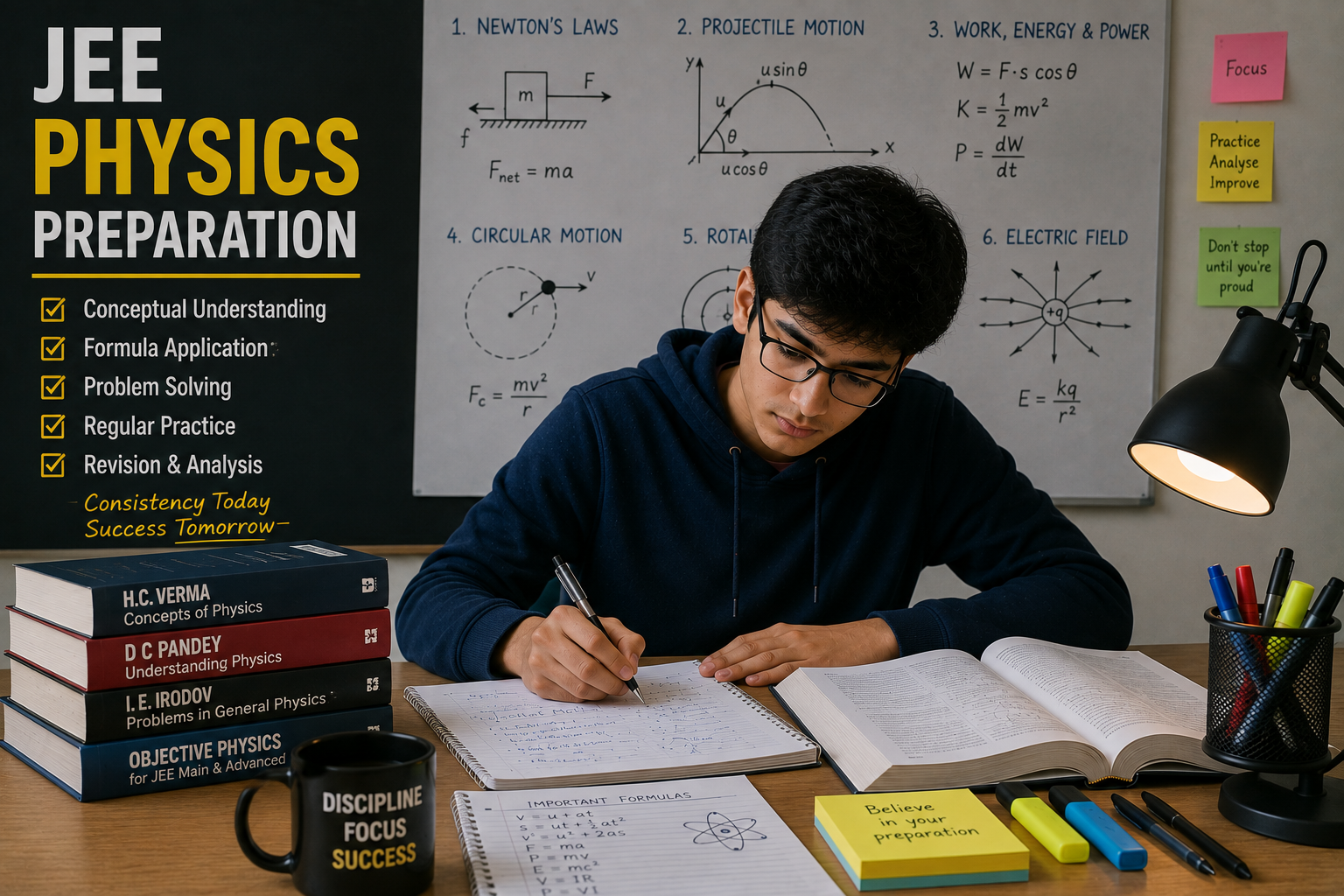
JEE Physics Preparation: Complete Strategy for JEE Main and JEE Advanced
Physics is one of the most important subjects in JEE preparation. For many students, it can also be one of the most challenging because Physics is not just about memorising formulas. To perform well, you need to understand concepts, visualise situations, apply mathematical tools and solve problems logically.
A student may know every formula from a chapter but still struggle with JEE questions. This usually happens because JEE Physics tests your ability to decide which concept to use, when to use it and how different concepts are connected.
The right approach to JEE Physics preparation can be summarised as:
Understand the Concept → Visualise the Situation → Learn the Application → Solve Questions → Analyse Mistakes → Revise Regularly
With consistent practice and the right strategy, Physics can become a strong scoring subject in both JEE Main and JEE Advanced.
Why Is Physics Important for JEE?
Physics plays a major role in both JEE Main and JEE Advanced.
The subject tests your ability to:
- Understand physical concepts
- Apply formulas correctly
- Analyse different situations
- Connect multiple concepts
- Solve numerical problems
- Interpret diagrams and graphs
- Manage calculations and time
JEE Main generally requires a combination of conceptual understanding, formula application, speed and accuracy.
JEE Advanced often requires deeper analysis. A single question may involve multiple concepts from different chapters, and the correct approach may not be immediately obvious.
Therefore, students should prepare Physics in a way that develops both speed and conceptual depth.
The Biggest Mistake in JEE Physics Preparation
One of the most common mistakes is treating Physics as a formula-based subject.
For example, a student may memorise:
F = ma
but struggle when asked to identify all the forces acting on an object.
The formula is simple, but applying it correctly requires understanding the physical situation.
Before using any formula, ask:
- What is happening in this situation?
- Which object am I analysing?
- What forces are acting?
- What information is given?
- What exactly do I need to find?
This habit can significantly improve your problem-solving ability.
How to Start Preparing Physics for JEE
The first step is to build strong fundamentals.
For every chapter, understand:
- Basic definitions
- Important laws and principles
- Formula derivations
- Conditions for applying formulas
- Units and dimensions
- Graphical interpretations
- Real-life applications
Do not move to difficult problems until the basic concepts are reasonably clear.
A strong Physics foundation is more valuable than quickly completing a large number of chapters.
The Best Way to Study a Physics Chapter
A structured approach can make your preparation more effective.
Step 1: Learn the Concept
Start by understanding the theory.
Attend your classes carefully or study from a reliable learning resource.
While learning, do not focus only on writing notes.
Try to understand:
- Why does this phenomenon happen?
- What principle explains it?
- What assumptions are being made?
- Where can this concept be applied?
If you can explain the concept in simple words, your understanding is usually improving.
Step 2: Understand Formula Derivations
You do not always need to memorise every derivation step by step.
However, understanding where important formulas come from can help you remember them and apply them correctly.
For example, instead of memorising a formula blindly, understand:
- What each variable represents
- How the variables are related
- Under what conditions the formula works
- What happens when a variable increases or decreases
This creates deeper understanding.
Step 3: Solve Basic Questions
Start with simple questions.
The purpose is to check whether you can apply the concept correctly.
Do not rush directly into the most difficult problems.
Step 4: Solve Different Types of Questions
Once your fundamentals are clear, practise questions with different situations.
For example, instead of solving ten identical questions on Newton’s laws, solve questions involving:
- Blocks on surfaces
- Inclined planes
- Friction
- Pulleys
- Connected bodies
- Accelerating systems
This helps you understand how the same concept can appear in different forms.
Step 5: Move to Advanced Problems
After developing confidence, attempt questions that involve multiple concepts.
For example, a question may combine:
- Newton’s laws
- Circular motion
- Work and energy
Initially, these problems may feel difficult.
Do not panic.
Break the question into smaller parts and identify the concepts involved.
Step 6: Analyse Your Mistakes
After solving questions, do not simply check whether the answer is correct.
Analyse why you made a mistake.
Common reasons include:
- Weak concept
- Incorrect formula
- Wrong assumption
- Calculation mistake
- Incorrect diagram
- Misreading the question
- Poor time management
Understanding the reason behind mistakes is essential for improvement.
Important Topics for JEE Physics
JEE Physics covers topics from both Class 11 and Class 12.
These can broadly be divided into:
- Mechanics
- Thermodynamics
- Oscillations and Waves
- Electrostatics
- Current Electricity
- Magnetism
- Electromagnetic Induction
- Optics
- Modern Physics
Instead of studying chapters randomly, follow a logical sequence wherever possible.
Many Physics topics are connected.
For example:
Kinematics → Laws of Motion → Work, Energy and Power → Circular Motion → Rotational Motion
A strong understanding of earlier topics makes advanced chapters easier.
How to Prepare Mechanics for JEE
Mechanics forms one of the most important foundations of Physics.
Important topics include:
- Units and Measurements
- Kinematics
- Laws of Motion
- Friction
- Work, Energy and Power
- Centre of Mass
- Circular Motion
- Rotational Motion
- Gravitation
The most important skill in Mechanics is learning how to visualise the problem.
When solving a Mechanics question:
Draw the Situation
Create a simple diagram.
Identify the Object
Decide which object or system you are analysing.
Draw All Relevant Forces
Use a free-body diagram where required.
Choose the Correct Principle
Ask whether the problem requires:
- Newton’s laws
- Work-energy theorem
- Conservation of energy
- Conservation of momentum
- Circular motion concepts
Solve Step by Step
Avoid jumping directly into calculations.
A properly drawn diagram often makes the solution easier.
How to Prepare Thermodynamics for JEE
Thermodynamics is an important chapter that requires both conceptual understanding and numerical practice.
Focus on understanding:
- Heat and temperature
- Work done by a system
- Internal energy
- First law of thermodynamics
- Thermodynamic processes
- Heat engines
- Efficiency
Instead of memorising different formulas separately, understand the relationship between heat, work and energy.
Pay attention to the conditions under which a process takes place.
For example:
- Isothermal process
- Adiabatic process
- Isochoric process
- Isobaric process
Understanding these conditions makes it easier to select the correct equations.
How to Prepare Oscillations and Waves
Oscillations and Waves require a combination of conceptual understanding and mathematical analysis.
Important areas include:
- Simple harmonic motion
- Time period
- Energy in SHM
- Wave motion
- Wave equation
- Superposition
- Standing waves
- Sound waves
Visualisation is especially useful in these chapters.
Try to imagine how an object moves during oscillation or how a wave travels through a medium.
Diagrams and graphs can help improve understanding.
How to Prepare Electrostatics and Current Electricity
Electricity is an important part of Class 12 Physics.
Important topics include:
- Electric charge
- Electric field
- Electric potential
- Capacitors
- Current
- Resistance
- Kirchhoff’s laws
- Electrical circuits
For circuit-based questions, do not immediately start calculating.
First analyse the circuit.
Try to identify:
- Series connections
- Parallel connections
- Potential differences
- Current direction
- Important junctions
Redrawing a complicated circuit in a simpler form can often make the problem easier.
How to Prepare Magnetism and Electromagnetic Induction
These topics require a clear understanding of the relationship between electricity and magnetism.
Important concepts include:
- Magnetic field
- Force on a moving charge
- Force on a current-carrying conductor
- Magnetic motion
- Electromagnetic induction
- Faraday’s law
- Lenz’s law
Visualisation is very important.
Try to understand the direction of:
- Magnetic fields
- Forces
- Motion
- Induced current
Do not rely only on memorising direction rules.
Understand the physical reason behind the result.
How to Prepare Optics for JEE
Optics includes:
- Reflection
- Refraction
- Mirrors
- Lenses
- Optical instruments
- Wave optics
Ray diagrams are extremely useful.
When solving optics questions:
- Draw the principal axis
- Identify the object position
- Understand the image formation
- Use sign conventions carefully
In Wave Optics, focus on concepts such as interference and diffraction instead of simply memorising formulas.
How to Prepare Modern Physics
Modern Physics is an important area of JEE preparation.
Topics may include:
- Dual nature of matter and radiation
- Atomic structure
- Nuclear Physics
- Semiconductors
Build conceptual clarity first and then practise numerical and application-based questions.
Because questions can be relatively direct in some areas, proper revision and practice can make these topics scoring.
How to Improve Physics Problem-Solving Skills
Physics problem-solving is a skill that develops gradually.
When you see a new question, avoid immediately searching for a formula.
Use this approach.
Understand the Situation
Read the question carefully.
Try to imagine what is happening.
Draw a Diagram
A simple diagram can help organise the information.
Write the Given Information
List the important values and conditions.
Identify What Is Required
Make sure you understand exactly what the question is asking.
Select the Relevant Concept
Think about which law or principle applies.
Create an Equation
Only after understanding the situation should you begin mathematical calculations.
Check Your Answer
Ask yourself whether the answer is physically reasonable.
For example:
- Is the unit correct?
- Is the value realistic?
- Should the answer be positive or negative?
- Does the result make sense based on the situation?
This final check can help catch mistakes.
The Importance of Diagrams in Physics
Many students try to solve Physics questions entirely through equations.
However, diagrams can save time and improve understanding.
Use diagrams for:
- Forces
- Motion
- Circular paths
- Electric fields
- Magnetic fields
- Ray optics
- Waves
- Circuits
A rough diagram does not need to be perfect.
Its purpose is to help you visualise the problem.
How Much Time Should You Spend on JEE Physics?
There is no fixed number of hours for every student.
Your study time depends on:
- Current preparation level
- Strengths and weaknesses
- School schedule
- Coaching schedule
- Other subject requirements
However, Physics requires regular practice.
Do not study a chapter once and then completely leave it for several months.
Maintain regular contact through:
- Question practice
- Formula revision
- Previous year questions
- Mixed-topic tests
Consistency is more important than occasional long study sessions.
How to Practise Physics Questions
A good Physics practice session should include questions of different difficulty levels.
Level 1: Basic Concept Questions
These test whether your fundamentals are clear.
Level 2: Standard Application Questions
These require applying a concept to a familiar situation.
Level 3: Multi-Concept Questions
These combine concepts from multiple areas.
Level 4: Advanced Questions
These require deeper analysis and problem-solving.
Gradually increase the difficulty level.
Do not start with advanced questions before building your foundation.
Previous Year Questions for JEE Physics
Previous year questions are an important part of preparation.
They help you understand:
- Actual examination level
- Question patterns
- Important concepts
- Application of formulas
- Time required to solve questions
After completing a chapter, solve relevant previous year questions.
Mark questions that are:
- Difficult
- Conceptually important
- Frequently based on a particular idea
- Questions where you made mistakes
These questions can be useful during revision.
How to Avoid Calculation Mistakes in Physics
Calculation errors can reduce your score even when your concept is correct.
To minimise mistakes:
- Write important steps clearly.
- Keep track of units.
- Check signs carefully.
- Avoid unnecessary calculations.
- Simplify expressions before calculating.
- Practise approximation where appropriate.
- Review the final answer.
Dimensional analysis can also help you identify certain mistakes.
If the final unit does not match the required physical quantity, recheck your solution.
Maintain a Physics Error Notebook
An error notebook can help you track repeated mistakes.
Write:
Chapter → Question Type → Mistake → Reason → Correct Approach
For example:
Chapter: Circular Motion
Mistake: Treated centripetal force as an additional physical force.
Reason: Did not properly identify the forces acting on the object.
Lesson: First draw the free-body diagram, then identify which forces provide the required centripetal force.
Review these mistakes regularly.
Over time, you may identify patterns that need improvement.
How to Revise JEE Physics
Revision should be active.
Do not simply read the same chapter repeatedly.
A good revision process includes:
Formula Revision
Maintain a concise formula notebook.
Concept Revision
Review important laws, conditions and assumptions.
Important Questions
Re-solve selected questions.
Error Review
Go through your mistake notebook.
Mixed Practice
Solve questions from different chapters.
Mixed practice is useful because the actual exam does not tell you which formula to apply.
You need to identify the concept yourself.
How to Prepare Physics for JEE Main
For JEE Main, focus on:
- Strong conceptual understanding
- Formula recall
- Numerical accuracy
- Speed
- Time management
Practise solving questions under timed conditions.
During mock tests, identify whether you are losing time because of:
- Difficult calculations
- Weak concepts
- Poor question selection
Work on the actual cause.
How to Prepare Physics for JEE Advanced
JEE Advanced requires deeper preparation.
Focus on:
- Strong fundamentals
- Multi-concept problems
- Analytical thinking
- Different approaches to the same problem
- Advanced previous year questions
Do not expect every question to look familiar.
When facing an unfamiliar problem, remain calm.
Break it into smaller parts.
Ask:
- What concepts are involved?
- What information is useful?
- Can the problem be simplified?
- Is there a conservation principle involved?
- Can I use a diagram or graph?
This thinking process is extremely important for advanced problem-solving.
Common Mistakes in JEE Physics Preparation
1. Memorising Formulas Without Understanding
A formula is useful only when you know where it applies.
2. Ignoring Basic Concepts
Advanced questions are built on fundamentals.
3. Not Drawing Diagrams
Visualisation can simplify complex questions.
4. Solving Only One Type of Question
Practise different situations and variations.
5. Looking at Solutions Too Quickly
Spend time thinking before checking the answer.
6. Ignoring Units and Signs
Small errors can change the entire answer.
7. Avoiding Difficult Chapters
Break difficult topics into smaller parts instead of ignoring them.
8. Not Revising Old Chapters
Physics concepts can become weak without regular revision.
9. Taking Tests Without Analysis
The score is only the result. Your mistakes tell you what needs improvement.
A Simple Weekly Physics Preparation Plan
A flexible weekly plan can look like this:
During the Week
Focus on:
- Current chapter
- Concept revision
- Regular question practice
Once or Twice a Week
Spend time on:
- Previous chapters
- Difficult concepts
- Weak areas
Weekend
Focus on:
- Chapter tests
- Mixed-topic questions
- Previous year questions
- Test analysis
- Revision of mistakes
Adjust the plan according to your overall JEE preparation schedule.
Final Thoughts
JEE Physics preparation is not about memorising the maximum number of formulas.
It is about understanding how the physical world works and learning how to apply that understanding to different problems.
A strong preparation cycle is:
Understand → Visualise → Apply → Practise → Analyse → Revise
Do not worry if difficult problems take time in the beginning.
Struggling with a question is often part of developing problem-solving ability.
Focus on building strong fundamentals first. Learn to draw diagrams, analyse situations and identify the correct principles before starting calculations.
Solve quality questions, review your mistakes and revise regularly.
With consistent practice and the right approach, Physics can become a strong and confident part of your JEE Main and JEE Advanced preparation.
