


NEET Exam Pattern 2026: Complete Paper Pattern, Marking Scheme & Exam Duration
Understanding the NEET Exam Pattern is an important part of NEET preparation. Knowing the number of questions, subject-wise marks, exam duration, marking scheme and question format helps students build an effective test-taking strategy.
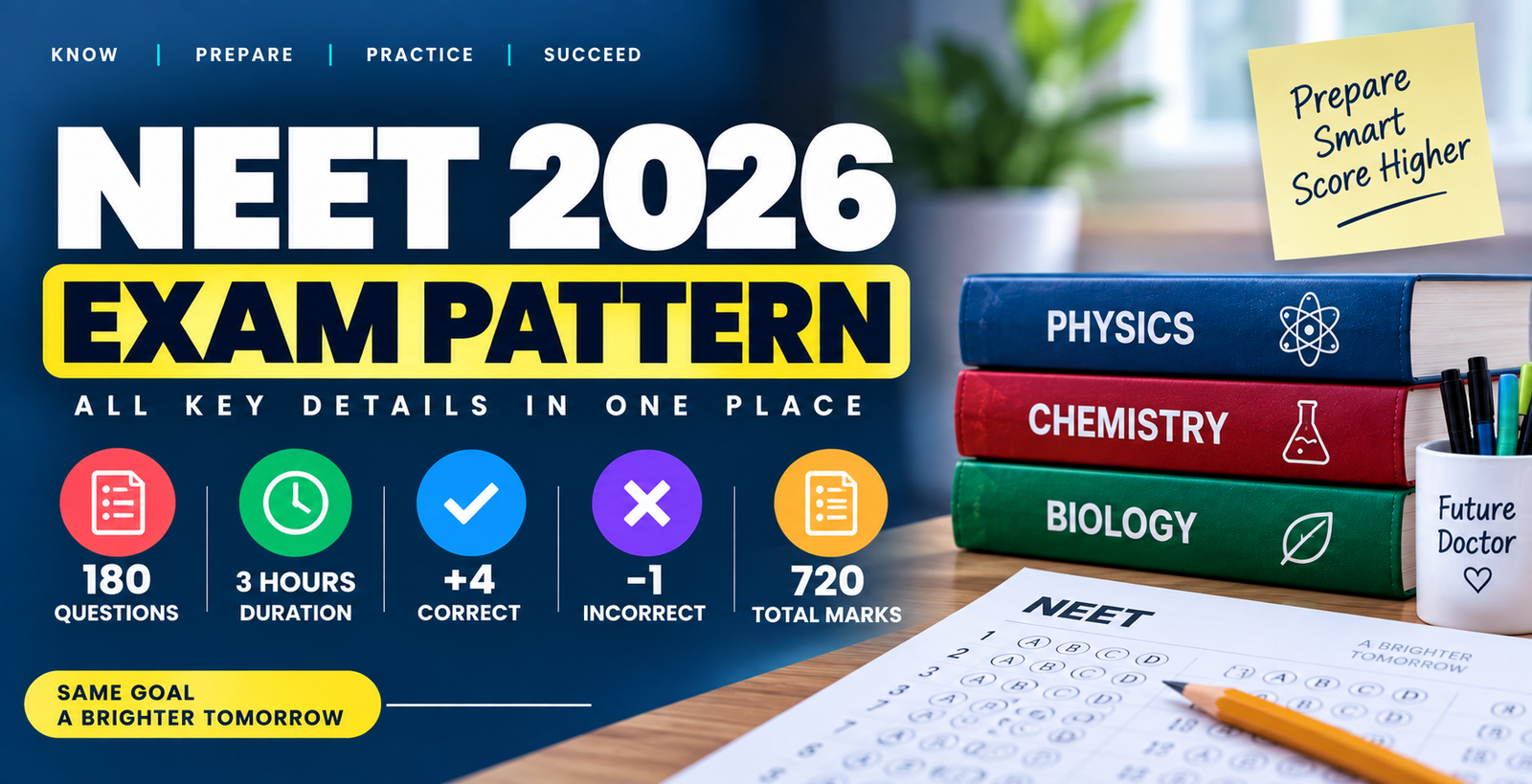
According to the official NEET UG 2026 Information Bulletin, the examination consists of 180 compulsory multiple-choice questions from Physics, Chemistry and Biology. Candidates get 180 minutes (3 hours) to complete the paper, for a maximum of 720 marks.
In this guide, we explain the complete NEET Exam Pattern 2026, including the subject-wise distribution, marking scheme, exam mode, question paper medium and useful preparation tips.
NEET Exam Pattern 2026 at a Glance
Here are the key details of the NEET UG 2026 examination pattern:
| Particular | NEET 2026 Details |
|---|---|
| Exam | NEET (UG) 2026 |
| Conducting Authority | National Testing Agency (NTA) |
| Exam Mode | Pen and Paper |
| Question Type | Multiple Choice Questions |
| Total Questions | 180 |
| Total Marks | 720 |
| Exam Duration | 3 Hours |
| Physics | 45 Questions – 180 Marks |
| Chemistry | 45 Questions – 180 Marks |
| Biology | 90 Questions – 360 Marks |
| Correct Answer | +4 Marks |
| Incorrect Answer | -1 Mark |
| Unanswered | 0 Marks |
The official NTA bulletin specifies that all 180 questions are compulsory and must be attempted within 180 minutes.
NEET Exam Pattern: Subject-Wise Distribution
The NEET question paper is divided into three subjects:
- Physics
- Chemistry
- Biology
Biology consists of Botany and Zoology.
The subject-wise distribution is:
| Subject | Questions | Marks |
|---|---|---|
| Physics | 45 | 180 |
| Chemistry | 45 | 180 |
| Botany | 45 | 180 |
| Zoology | 45 | 180 |
| Total Biology | 90 | 360 |
| Grand Total | 180 | 720 |
Physics and Chemistry each contribute 25% of the total marks, while Biology contributes 50%.
NEET Physics Exam Pattern
Physics contains:
45 Questions = 180 Marks
Each Physics question has four options, with one correct or best answer.
Physics can require a combination of:
- Conceptual understanding
- Formula application
- Numerical calculation
- Graph interpretation
- Logical reasoning
Because the subject contains numerical questions, time management is particularly important during practice.
Physics Marks
45 × 4 = 180 marks
A wrong answer results in a deduction of one mark.
NEET Chemistry Exam Pattern
Chemistry contains:
45 Questions = 180 Marks
Questions can cover different areas of Chemistry, including:
- Physical Chemistry
- Organic Chemistry
- Inorganic Chemistry
Students should prepare for a combination of conceptual, numerical and application-based questions.
Chemistry Marks
45 × 4 = 180 marks
As with the other subjects, an incorrect answer receives -1 mark under the official marking scheme.
NEET Biology Exam Pattern
Biology has the largest share of the NEET question paper.
It contains:
90 Questions = 360 Marks
Biology is divided into:
- Botany – 45 questions
- Zoology – 45 questions
Together, Botany and Zoology account for half of the total NEET marks.
Biology Marks
90 × 4 = 360 marks
Because Biology has the largest number of questions, regular NCERT reading, revision and MCQ practice are important parts of preparation.
NEET Marking Scheme 2026
The official NEET 2026 marking scheme is straightforward.
Correct Answer
+4 marks
Incorrect Answer
-1 mark
Unanswered Question
0 marks
The NTA bulletin also specifies how questions with multiple correct options or dropped questions are handled.
How Is the NEET Score Calculated?
A simple formula can be used to understand your raw score:
NEET Score = (Correct Answers × 4) − (Incorrect Answers × 1)
For example, suppose a student attempts 170 questions and gets:
- 140 correct
- 30 incorrect
- 10 unanswered
The score would be:
140 × 4 = 560
30 × 1 = 30
Therefore:
560 − 30 = 530 marks
The 10 unanswered questions receive zero marks.
Why Negative Marking Matters in NEET
Because every incorrect answer results in a deduction of one mark, students should avoid making random guesses.
For example:
If you answer 10 questions incorrectly:
10 × -1 = -10 marks
Those marks can make a meaningful difference to the final score.
This does not mean students should avoid attempting every question they can reasonably solve. Instead, develop a question-selection strategy through regular timed practice.
NEET Exam Duration
The NEET UG 2026 examination duration is:
180 minutes = 3 hours
The official examination timing for NEET UG 2026 was specified as 2:00 PM to 5:00 PM IST.
With 180 questions to answer in 180 minutes, students have an average of approximately one minute per question.
However, this does not mean you should spend exactly one minute on every question.
Some questions may take only a few seconds, while numerical or conceptual questions may require more time.
NEET Exam Mode
For NEET UG 2026, the examination is conducted in Pen and Paper mode on a single day and single shift. Candidates answer the questions using the prescribed OMR answer sheet.
This makes OMR practice an important part of preparation.
Students should become comfortable with:
- Reading questions carefully
- Selecting answers
- Marking the OMR sheet correctly
- Managing time
- Avoiding accidental markings
NEET Question Type
The NEET 2026 paper consists of Multiple Choice Questions (MCQs).
Each question has:
- Four options
- One correct answer or best option
The candidate must select the option corresponding to the correct or most appropriate answer.
NEET Question Paper Medium
For NEET UG 2026, question papers were available in 13 languages:
- English
- Hindi
- Assamese
- Bengali
- Gujarati
- Kannada
- Malayalam
- Marathi
- Odia
- Punjabi
- Tamil
- Telugu
- Urdu
Candidates choosing English receive an English-only paper, while candidates selecting Hindi or a regional language receive a bilingual paper containing English and the selected language.
The English version is treated as final in case of ambiguity in translation.
NEET Exam Pattern and Time Management
Since NEET provides three hours for 180 questions, time management should be practised well before the actual examination.
A possible practice strategy is to divide your time between subjects.
For example:
| Subject | Approx. Practice Time |
|---|---|
| Biology | 50–60 minutes |
| Chemistry | 45–50 minutes |
| Physics | 60–70 minutes |
| Review | Remaining time |
This is only a practice framework. Every student should develop a time strategy based on their own speed and accuracy.
How to Attempt the NEET Paper
There is no single sequence that every student must follow.
Some students may prefer:
Biology → Chemistry → Physics
Others may prefer:
Chemistry → Biology → Physics
Or:
Physics → Chemistry → Biology
The best approach for you should be determined through full-length mock tests.
Try different sequences during practice and evaluate:
- Accuracy
- Time used
- Questions left
- Number of silly mistakes
- Confidence level
Then use the approach that fits your preparation.
NEET Biology Time Management
Biology contains 90 questions and accounts for 360 marks.
Since there are many questions, students should avoid spending too much time on a single difficult question.
A useful approach is:
- Read the question carefully.
- Identify the key concept.
- Eliminate clearly incorrect options.
- Select the answer.
- Move forward if the question is taking too long.
- Return to difficult questions later.
Regular NCERT-based MCQ practice can help improve speed.
NEET Chemistry Time Management
Chemistry contains 45 questions.
Students should practise switching between different question types.
For example:
- Direct factual question
- Conceptual question
- Numerical question
- Reaction-based question
If a numerical problem is taking too much time, mark it for review and continue with questions you can solve more efficiently.
NEET Physics Time Management
Physics contains 45 questions for 180 marks.
During mock tests, practise:
- Identifying formulas quickly
- Estimating calculations
- Recognising familiar question types
- Avoiding lengthy calculations when a simpler approach exists
- Moving past questions that are consuming excessive time
The goal is not simply to solve every question immediately. It is to use the available time efficiently.
NEET OMR Strategy
Because the NEET examination is conducted in pen-and-paper mode, OMR handling is an important skill.
During mock tests:
- Use the same type of marking method you expect to use in the examination.
- Avoid careless bubbling.
- Check the question number before marking.
- Keep track of the question sequence.
- Avoid unnecessary corrections.
- Practise completing OMR sheets under timed conditions.
Your preparation should include not only solving questions but also becoming comfortable with the examination format.
NEET Exam Pattern: Important Changes to Know
Students should always check the latest official NTA Information Bulletin because the examination pattern can be updated by the authorities.
For NEET UG 2026, NTA explicitly stated that the paper consists of 180 compulsory questions, with no optional-question section.
Therefore, students preparing using older material should verify that their study resources reflect the current examination pattern.
NEET Exam Pattern vs NEET Syllabus
The NEET syllabus and NEET exam pattern are different.
NEET Syllabus
Tells you:
- What topics to study
- Which concepts are included
- Subject-wise units
- Physics, Chemistry and Biology content
NEET Exam Pattern
Tells you:
- Number of questions
- Marks
- Question format
- Exam duration
- Marking scheme
- Exam mode
- Subject-wise distribution
You need both to create a complete preparation strategy.
How to Prepare According to the NEET Exam Pattern
Understanding the pattern should directly influence your preparation.
1. Practise MCQs
Don’t rely only on reading.
Solve questions regularly.
2. Take Timed Tests
Practise completing questions within a fixed amount of time.
3. Take Full-Length Mock Tests
Simulate the actual three-hour examination environment.
4. Analyse Your Mistakes
After every test, classify mistakes into:
- Conceptual
- Factual
- Calculation
- Silly mistake
- Time-management
- Guessing
5. Practise OMR
Since the examination is pen-and-paper based, include OMR practice in your mock-test routine.
Common Mistakes Students Make in NEET
Spending Too Long on One Question
One difficult question should not consume several minutes unnecessarily.
Guessing Randomly
Negative marking means incorrect answers can reduce your score.
Ignoring Mock Tests
Reading and question practice alone cannot fully simulate the examination environment.
Not Analysing Tests
A mock test becomes much more useful when you identify why you lost marks.
Ignoring OMR Practice
Students should become comfortable with the pen-and-paper format before the actual examination.
Poor Time Allocation
Spending too much time on one subject can leave insufficient time for another.
NEET Exam Pattern: Quick Revision
Before the examination, remember these key numbers:
180 Questions
720 Maximum Marks
180 Minutes
45 Physics Questions
45 Chemistry Questions
90 Biology Questions
+4 for Correct
-1 for Incorrect
0 for Unanswered
These are the core details of the NEET UG 2026 pattern specified in the official NTA Information Bulletin.
Frequently Asked Questions About NEET Exam Pattern
How many questions are there in NEET?
The NEET UG 2026 paper contains 180 compulsory questions.
How many marks is NEET worth?
The maximum score is 720 marks.
How many Physics questions are there in NEET?
There are 45 Physics questions, carrying a total of 180 marks.
How many Chemistry questions are there in NEET?
There are 45 Chemistry questions, carrying 180 marks.
How many Biology questions are there in NEET?
There are 90 Biology questions, comprising Botany and Zoology, for a total of 360 marks.
Is there negative marking in NEET?
Yes. Under the NEET UG 2026 marking scheme, a correct answer receives +4 marks, an incorrect answer receives -1 mark, and an unanswered question receives 0 marks.
How long is the NEET exam?
The NEET UG 2026 examination duration is three hours (180 minutes).
Is NEET conducted online?
For NEET UG 2026, NTA specified a Pen and Paper mode examination conducted in a single day and single shift.
Where can I check the official NEET exam pattern?
Students should refer to the latest Information Bulletin published on the official NTA NEET website for the current examination pattern and instructions.
Final Thoughts
Understanding the NEET Exam Pattern is an essential part of your preparation. Once you know the question distribution, marking scheme, time limit and subject-wise weightage, you can design your mock-test and revision strategy accordingly.
For NEET UG 2026, the official pattern consists of 180 compulsory MCQs for 720 marks, with 45 questions each from Physics and Chemistry and 90 questions from Biology. The examination duration is three hours and the marking scheme is +4 for a correct answer, -1 for an incorrect answer and 0 for an unanswered question.
Keep checking the official NTA website for any updates or changes to the examination pattern before your exam.
Prepare With Toppers Live
For more NEET preparation strategies, exam tips, study plans, revision techniques and educational videos, subscribe to Toppers Live on YouTube.
